Lockdown travel series – Part 7: Travel essentials

Thinking about travelling during a lockdown that seems to have no clear end may seem like a futile exercise, but it is not. It might be a while before we can safely travel beyond Ashford or Egham, but this is a good time to look and think ahead.

It’s time now to, having whetted your appetite with routes and destinations, to look again at some practicalities. Namely, what to take with you.

If in doubt, leave it out

While the beauty of rail and sea travel is that you can generally take as much as you’re able to carry, that doesn’t mean that you should. Certainly the enjoyment of any trip is in inverse proportion to the amount of stuff you bring with you. The key maxim here is ‘If in doubt, leave it out’. If, further down the line (so to speak) you realise there’s something you really should have packed, you can buy it locally. Those boxer shorts, bought in Belgrade, will be a unique souvenir of your trip too.

The European Rail Timetable and Map        

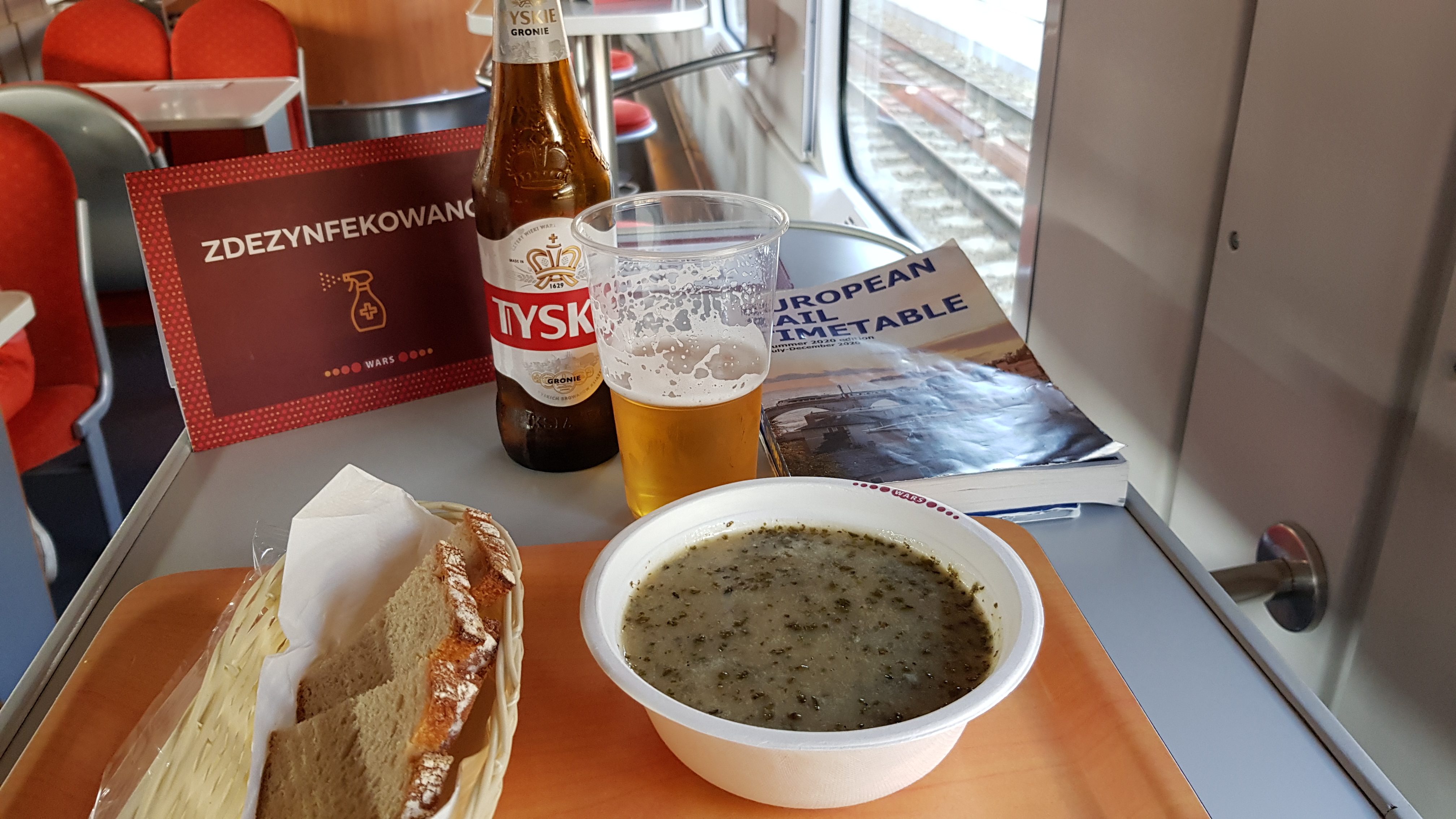
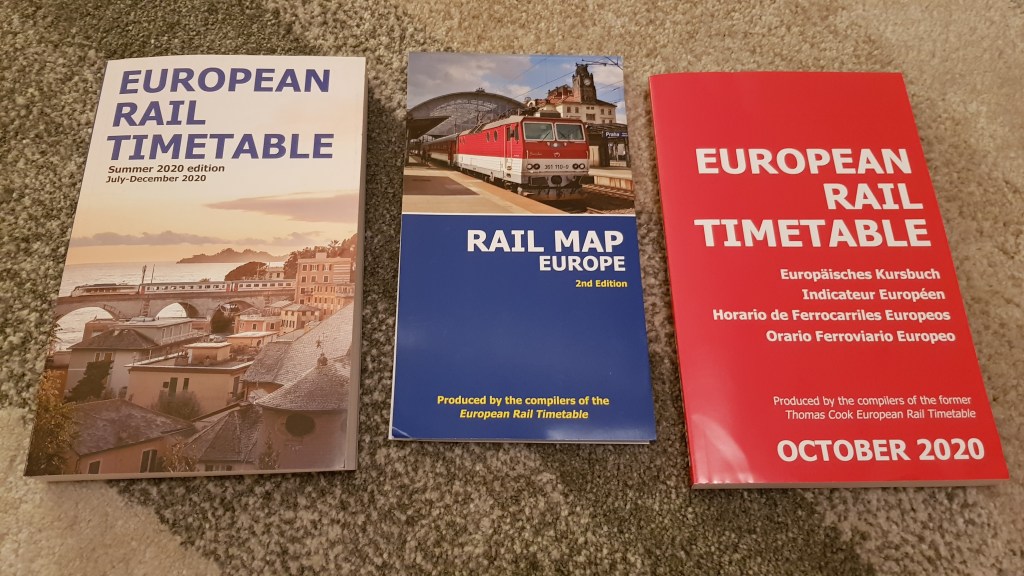
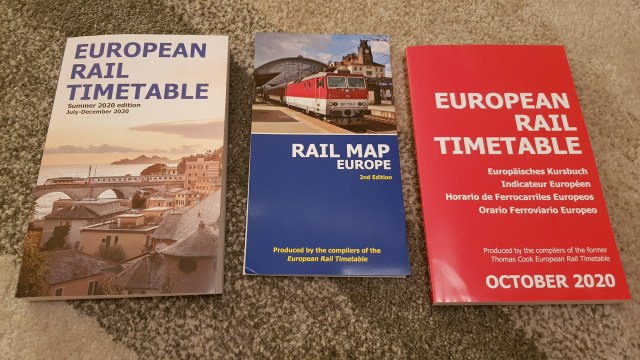
This is something you should have no doubt at all about packing in your bag – especially since, unlike clothes, it’s not easy to pick up on the road. Yes, you can just rely on a smartphone, but sometimes a proper map and a timetable can get you ahead of the game. Trying to ‘plan as you go’ is easier when you can visualise your route and connections – something an electronic device just doesn’t do so well. Order at https://www.europeanrailtimetable.eu/ and try to get the winter or summer edition. It will be like travelling with a very knowledgeable friend – like me, for example.
A good bag

This is important to get right – as your bag really will be both your friend and your enemy throughout your trip. Ideally, try to think ‘cabin bags’ when it comes to size and weight. As I said ‘If in doubt, leave it out’. If you want to buy souvenirs and other objets d’art, you can also pick up a cheap case or bag for the return journey. But on departure from Staines, you need to be travelling light.

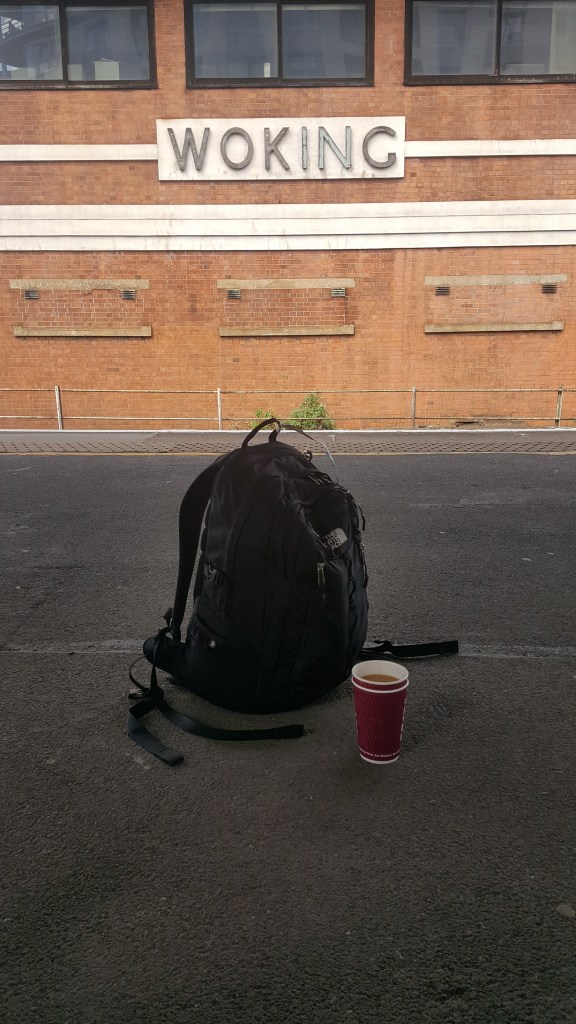
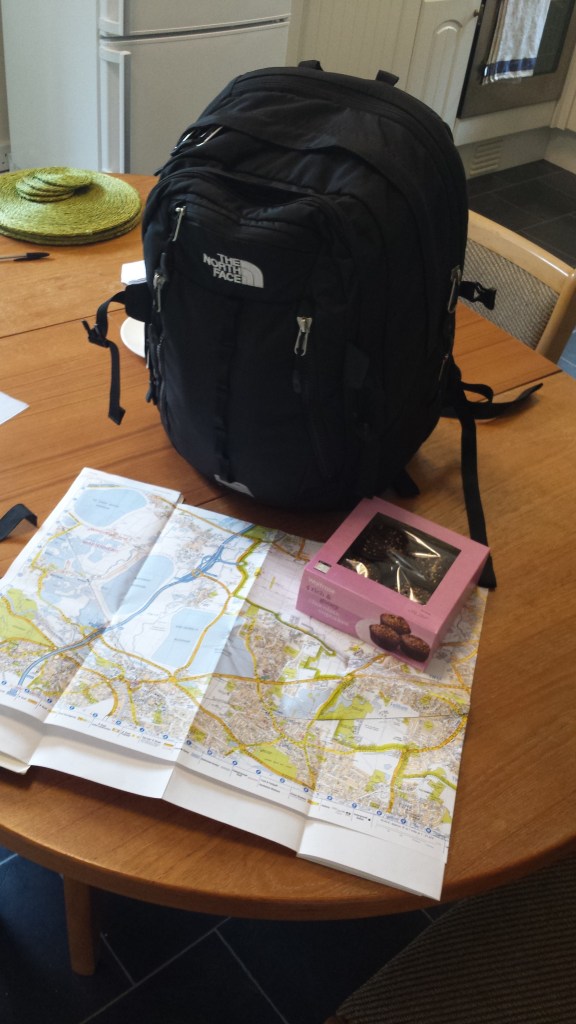
Essentially there are two luggage options – backpack or wheelie case. I prefer a small backpack (like a large laptop bag) to a huge rucksack. In fact my last one (from the reliable North Face) has lasted me a good six years and is still going strong. It’s quite enough for any trip from four days to a month.

Others may prefer a cabin-sized wheelie case. It’s really up to you and what you prefer. If you are travelling with people who might need assistance (children, older travellers), they are better off with a wheelie case (while you have a backpack) as you can then more easily take their case up the inevitable steps that any rail or bus journey seems to involve.

When putting actual things in the bag (like clothes), the best policy is to always pack for one week’s worth of travel – no matter how long the trip will last (unless of course it is less than a week). You do not need multiple pairs of shoes, or a different outfit for morning, afternoon, and evening.

If you do use a wheelie case, slip a small daypack inside, for use for days out when you want to leave your luggage at your accomodation.
Tea and coffee facilities

In the UK, even the cheapest, roughest, most basic hotel will have ‘tea and coffee facilities’ in each room. The bed may be awful, the loo down the corridor, and the room rates by the hour, but there’ll always be the chance to make a nice cup of tea.

This is most definitely not the case on the continent. Make sure you grab a final cup of tea as the Eurostar speeds through the Paris suburbs, because unless you come equipped, you won’t be enjoying one again until your trip is over. It’s no good ordering a cuppa in a cafe or restaurant either – British people often do, and get a very nasty shock. Lukewarm water, ‘tea’ bags that barely raise a tint, and a curious lack of milk mean that having a much-needed cup of tea in continental Europe is almost an impossibility. Even the poshest hotels, like the grand Hotel Moskva in Belgrade, will only ever disappoint.

For this reason, the sensible traveller always comes equipped. You will need the following:

  • Tea bags – preferably Waitrose Gold ‘Extra Strong’, as these are both strong and have a lovely taste. It’s also fair trade.
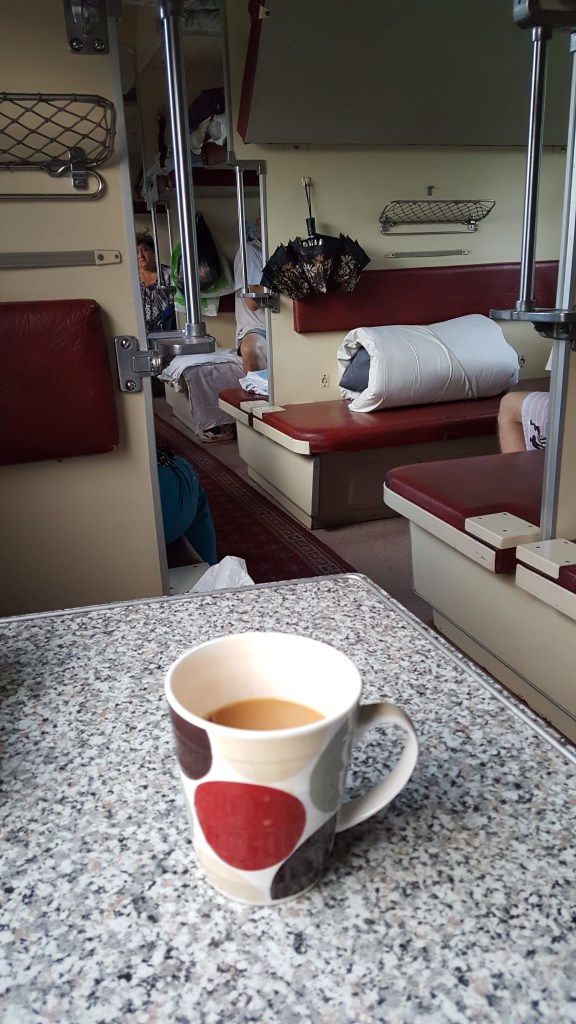
  • A mug – personally I prefer a proper mug. Others might want to take some form of travel mug, but the tea never tastes quite as good.
  • A teaspoon – don’t forget the teaspoon!
  • Sugar – if you need it.
  • Milk – Milk is the big problem, as carrying around a pint of semi-skimmed won’t really work. A carton of UHT will also go off pretty quickly too, once opened. Those little mini-portions of milk can be handy, but check it is UHT (and doesn’t need refrigerating) – and beware they leak very easily. The best solution is a sealed tupperware pot of dried skimmed milk powder (such as ‘Marvel), which can be added to your tea (sparingly) when it has cooled a touch.
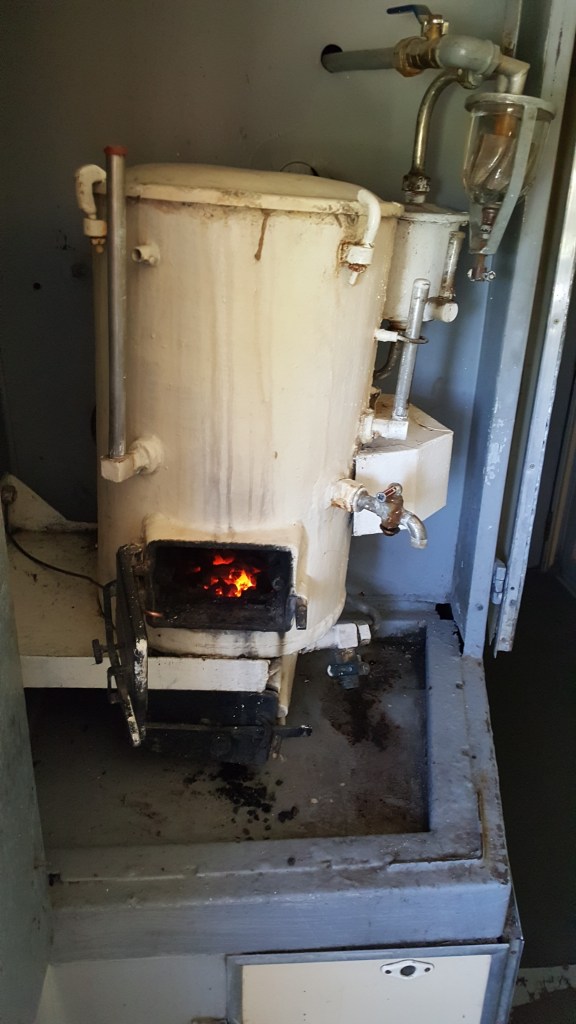
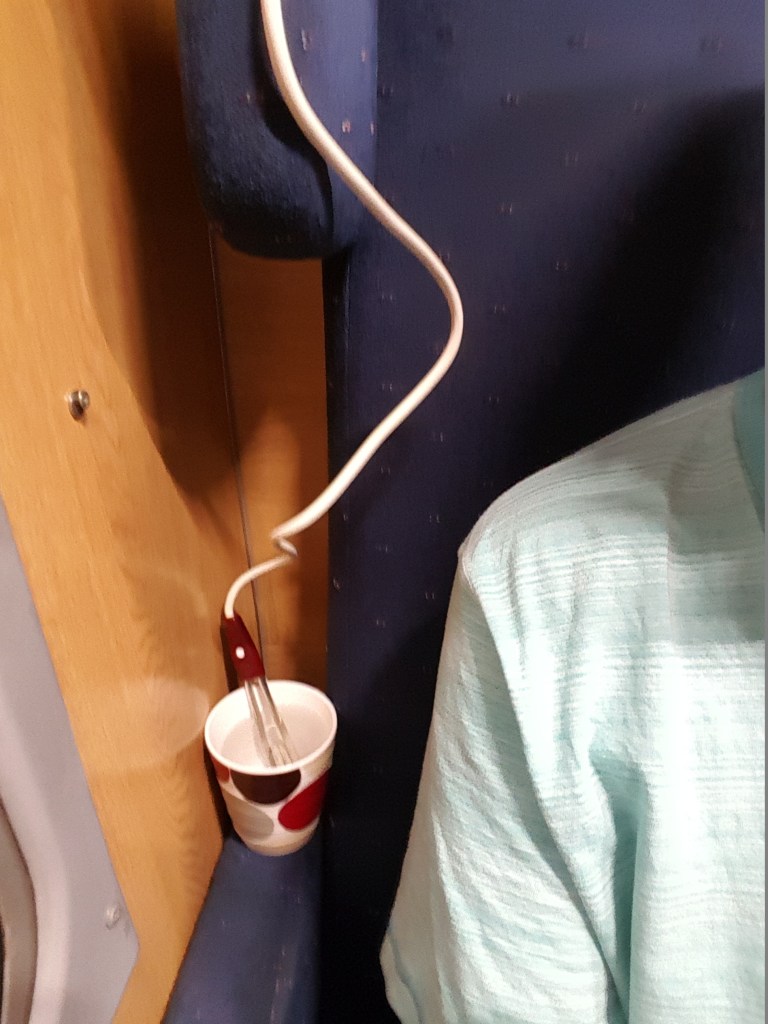
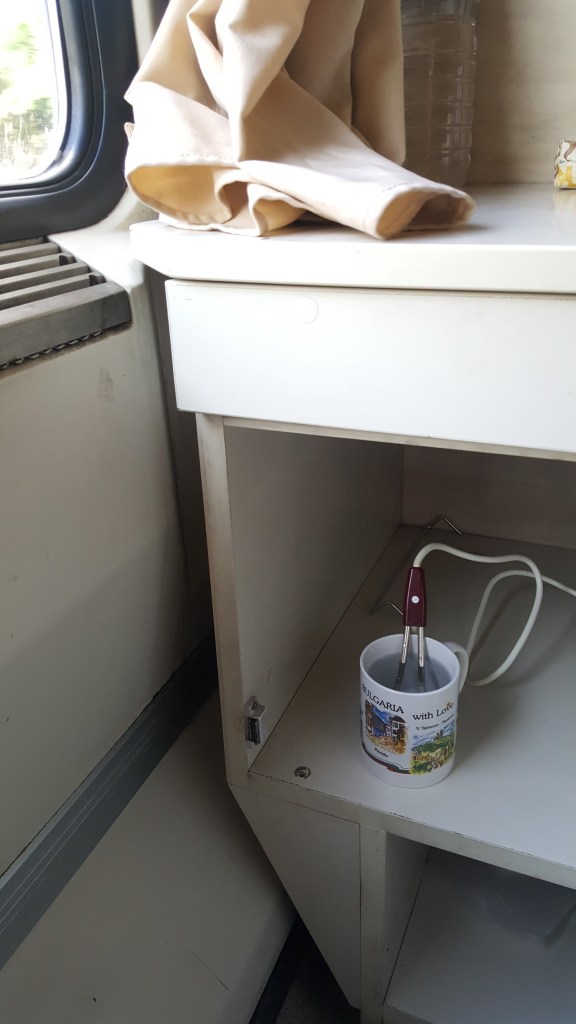
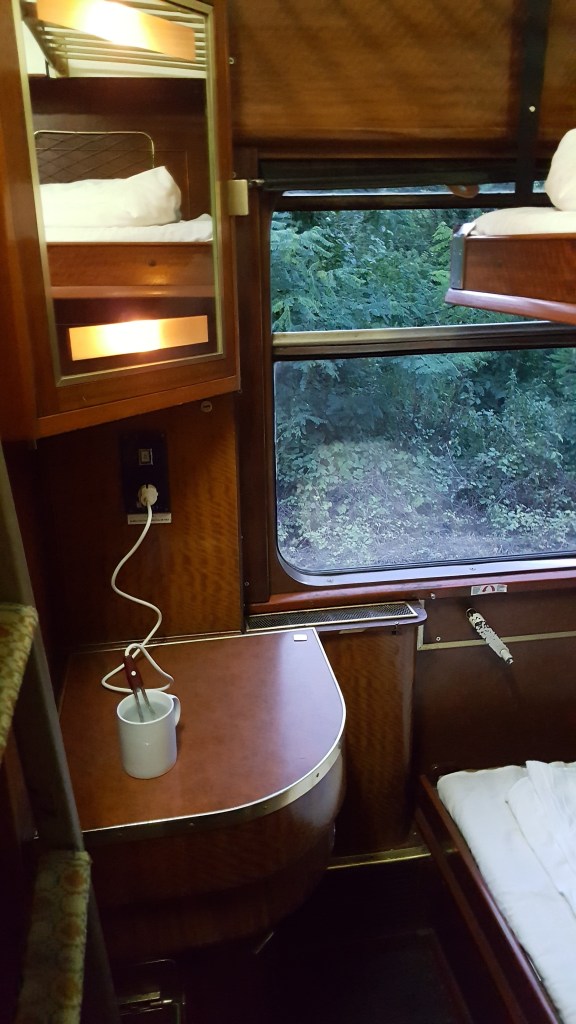
  • A travel kettle – Trying to get water that is hot enough (i.e. actually boiling) for a cup of tea can be quite a challenge. Some cafes will oblige, and trains in the former USSR often feature a samovar at the end of the corridor – but it is a good idea to bring your own heating equipment. A small travel kettle is ideal, or (if you can find one) a portable heating element. I have an element that used to belong to my grandmother – and I take it with me everywhere. It is almost certainly illegal now!

We need, at this point , to have a word about America. Generally, in the United States and Canada you’ll have no problem getting a great cup of coffee, but there is absolutely no concept whatsoever of tea. Some hotels may leave some nice Twinnings tea bags in the room – but they will be as good as useless. This is because our north Atlantic cousins have an electricity supply that seems to be the equivalent of two AA batteries. The low voltage (110 volts) and flimsy wiring means that, unless you source a 110 v travel kettle, you’ll be waiting a couple of days for the water to boil. One solution is to try to make your tea using the ubiquitous coffee maker, but unless you like tepid, coffee-like tea, I would, if I were you, try to get help immediately.

What not to pack

It is not unheard of to lose your luggage or have it nicked. As a principle, you should never pack in such a way that the loss of your luggage would cause the curtailment of your trip. Yes, it will be inconvenient travelling without a change of clothes, and downright foolhardy with any decent tea bags, but the reality is that you can still (just about) live without them. Of course it will take a day or so to recover your sense of fun, but don’t be silly and rush home. Your adventure, after all, is only just beginning.

For this reason, do not put money, passport, phone, tickets, or other irreplaceable documentation in your bag. Carry them on your person. This includes when you are asleep in a night train – if sharing with strangers.

The most sensible investment then is in a concealed wallet. Forget about a money belt, as opening this sweaty pouch makes it look like you are about to expose yourself every time you buy something. Instead a flat wallet that can hang around your neck is the best choice. This should be worn inside your clothing, not on top of it – unless you want to invite trouble.

When you are on a night train, and if you would like to remove it – keep it in bed with you, attached to one of your body parts – and if you need to get up in the night for some reason, take it with you!
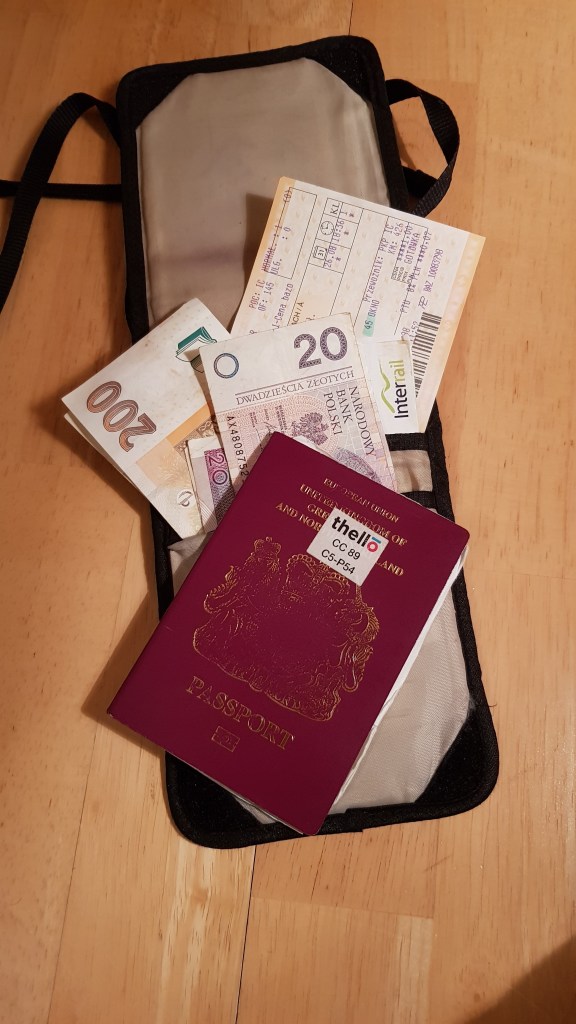
A shopping bag

As you prepare to rush out the door, don’t forget to stuff a reusable shopping back, like what you get at Waitrose or Sainsburys, into your luggage. It is handy for all sorts of things – for sitting on when you’ve got to sit on the ground, for containing your leaky shampoo bottle, for putting your dirty washing in, for trips to the supermarket, and for packing your souvenirs in for the return journey, or using as ‘hand luggage’ should you check in your main bag. In the most exotic parts of the world, a bag that says ‘every little helps’ shows everyone what a seasoned and experienced traveller you really are.

Swimming trunks

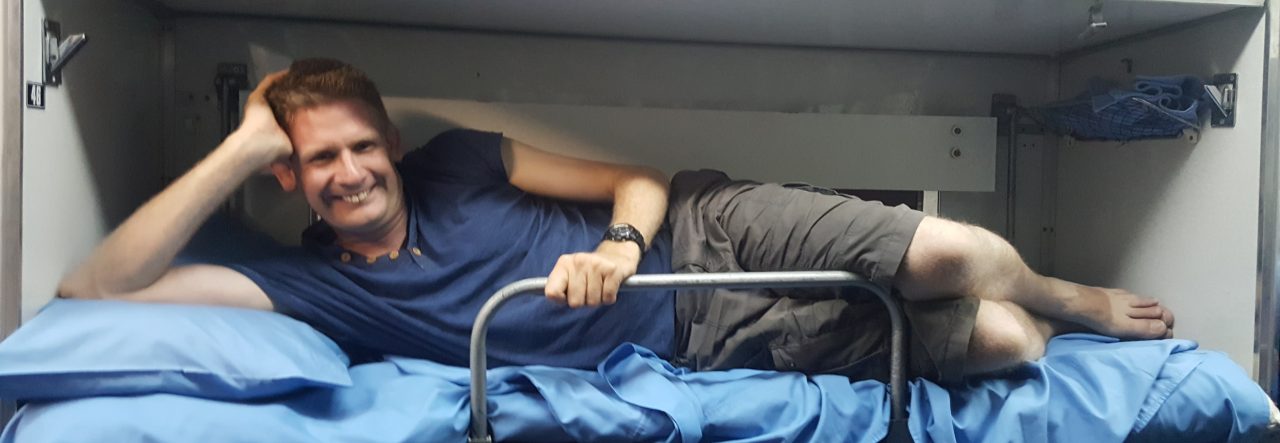
It is likely that at some point or other you will see a body of water and want to jump into it – but even if not, swimming trunks can be useful. In some shared night train accommodation, stripping down to your underwear is not the done thing – but a pair of loose trunks (not Speedos obviously…) will make for a more comfortable sleep than wearing your day clothes all night.
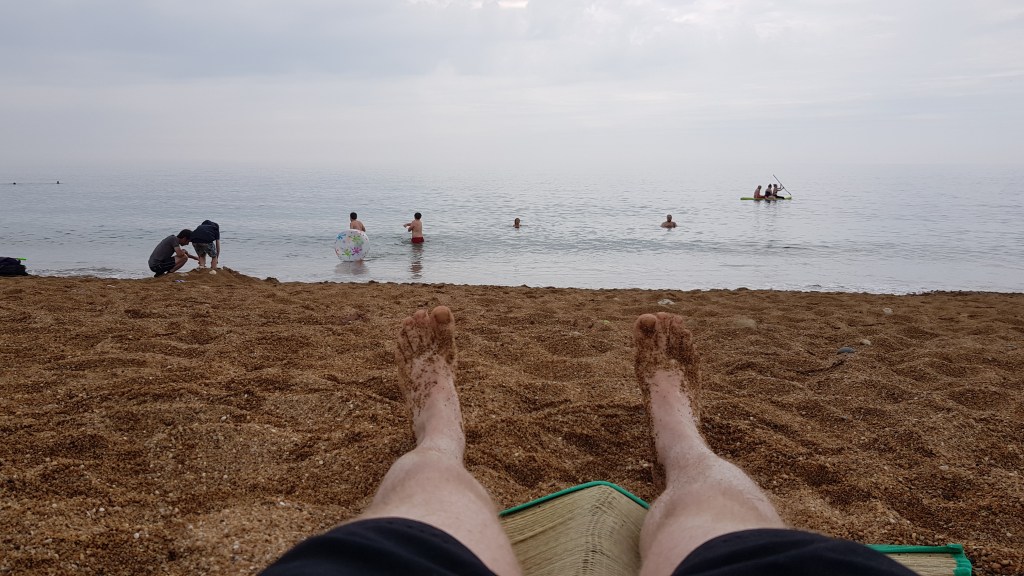
Never forget your trunks

Conclusion

I’m sure you could add to this list, as everyone has their favourite ‘essentials’. But just don’t forget ‘if in doubt, leave it out’!
Lockdown Travel Series – Part 6: Routes to Poland

Getting to Poland by train

For some reason or other, Poland seems to be a very popular destination among our parishioners. In more conventional times, some people even go to Poland every year or even more often. I’ve no idea why this is.So, one of the most frequent travel questions I get is ‘How can I get to Poland by train?’ A lot of people harbour a desire to travel this way, but when push comes to shove, end up flying or driving. So the purpose of this post is to explain the various rail options.

A dose of realism

First, a dose of realism. Much as I love rail travel, the reality is that travelling by rail can take longer and cost more money. The length of the journey is less of an issue – as everyone knows it’s a long way, but the cost is more of a consideration. Simply put, if you want to travel to Poland by train, you need to be prepared to pay more. Except in the following circumstances:

  • You are travelling with children (children and trains are usually a value-for-money combination due to high kids’ air fares)
  • You are going to a part of Poland where flight choices are more limited
  • You plan to visit other parts of Europe (and hence take advantage of rail passes etc.)
  • You’ve all got more than just cabin bags (and you don’t mind carrying your luggage with you the whole way).

However, the real reason for travelling to Poland (or indeed many other European countries) by rail is for the sheer enjoyment and adventure of the experience.

Take your time

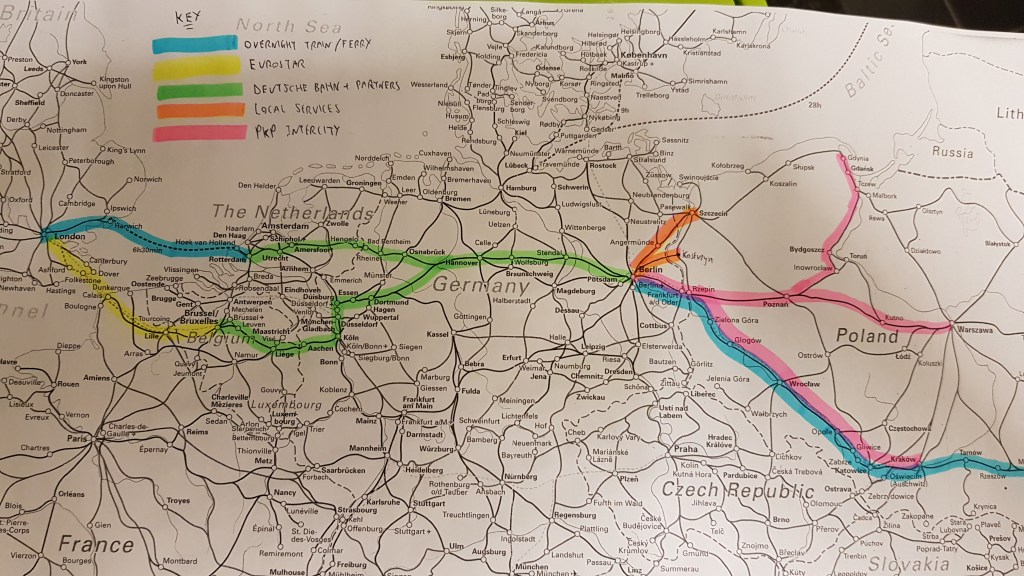
With a favourable wind and good punctuality, it’s possible to travel from Staines as far as Warsaw or Wrocław (and intermediate points such as Poznan) within one long day. However, the possibility of delays and missed connections means that you’ll be brave to attempt this – unless you are only going as far as Szczecin.

But in any case, an overnight stop, especially when travelling with people you still hope to be able to love afterwards, is sensible. As pretty much all rail routes to Poland require a transit of Berlin, this is obviously the best place to stop. Other advantages are that hotel accommodation is plentiful and (by German standards) relatively cheap and the city itself is interesting enough to be more than just a stopover.

Getting to Berlin

(skip this section for the more interesting Polish details further down)

So, think of your journey to Poland in two parts: Staines to Berlin and Berlin to your Polish destination.There are basically two ways of getting from Staines to Berlin.

Staines to Berlin via Eurostar

This is simple. Leave Staines around 05.00, head to St. Pancras, and take an early Eurostar train to Brussels, and continue to Berlin with German Railways, changing at Cologne. You’ll need to make two bookings.

Use http://www.eurostar.com to get you to Brussels

Use http://www.bahn.de to get you from Brussels to Berlin.

Sample times:

London 06.47 – Brussels 10.07

Brussels 10.25 – Cologne (Koln) 12.15

Cologne 12.48 – Berlin 17.06

The same connection is repeated two hours later, and then two hours after that, with correspondingly later arrival times. I would take the first connection, as if things go wrong at, say, Brussels, you’ll be able to catch a later train (and maybe go visit the Manneken Pis and have some waffles while you wait).

Staines to Berlin via Ferry

This saves neither time nor money, but is arguably a more relaxed and enjoyable journey.

Every night, at 19.32, a train leaves London’s Liverpool Street Station for various unremarkable Essex towns, terminating at Harwich International Port. This late evening service, full of commuters and shoppers returning to the likes of Romford and Colchester is the only remaining ‘Boat Train’ in the UK, connecting with the overnight ferry to the Hook of Holland.

On arrival at Harwich, a quick check-in and a short walk will bring you to your cosy cabin on board the Stena Britannica. You’ll be aboard around 9 pm, with time to have a nice meal or a few drinks at the bar, before retiring to a very comfortable bed. After a smooth crossing, it’s an early morning arrival in Hoek van Holland, where a short ride on the Metro will take you to Schiedam.

It’s necessary do your homework on where to change trains, but it’s another short ride to Amersfoort, where you can catch a direct train to Berlin, arriving at 17.22.

You’ll need to make two bookings:

To get from London to Hoek van Holland, use http://www.stenaline.co.uk/ferry-to-holland/rail-and-sail

Buy ticket locally for metro (have some euro coins!)

To get from Rotterdam to Berlin, use http://www.bahn.de

Sample times:

London 19.32 – Harwich 20.54

Check in and board ferry, arriving at 08.00

Metro transfer to Schiedam Centrum, local train to Rotterdam Centraal

Rotterdam 10.05 – Amersfoort 11.02

Amersfoort 11.36 – Berlin 17.22

Routes to Poland

Getting from Berlin to Poland

After a pleasant night or two (or perhaps just a hour or so if you’re not staying over), a whole suite of trains run to various destinations in Poland. Most are direct. The easiest thing is to list these services in turn.

Regionalbahn to Kostrzyn

An hourly local service runs from Berlin-Lichtenberg (not the main station) to the border town of Kostryn. From here, it’s possible to take another train to Gorzow and Krzyz. If you are feeling lucky, this is all possible in one day from Staines.

Regional Express to Szczecin

Around nine trains a day run over the border to the beautiful city of Szczecin. Most require a change en route, but a handful run there directly from Berlin-Gesundbrunnen (not the main station). Again, if you are feeling lucky, this is all possible in one day from Staines.

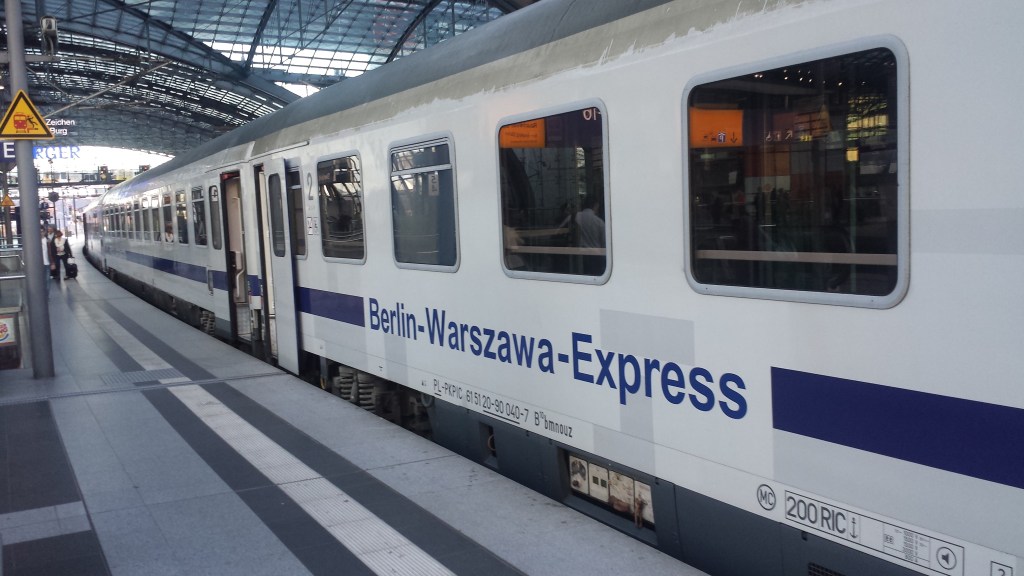
The Berlin-Warszawa-Express

Running five times a day to Poznan and Warsaw, this comfortable but not exactly speedy train is the flagship of German-Polish friendship. The journey takes a relaxing six hours, calling at the rather nice town of Poznan half way through.

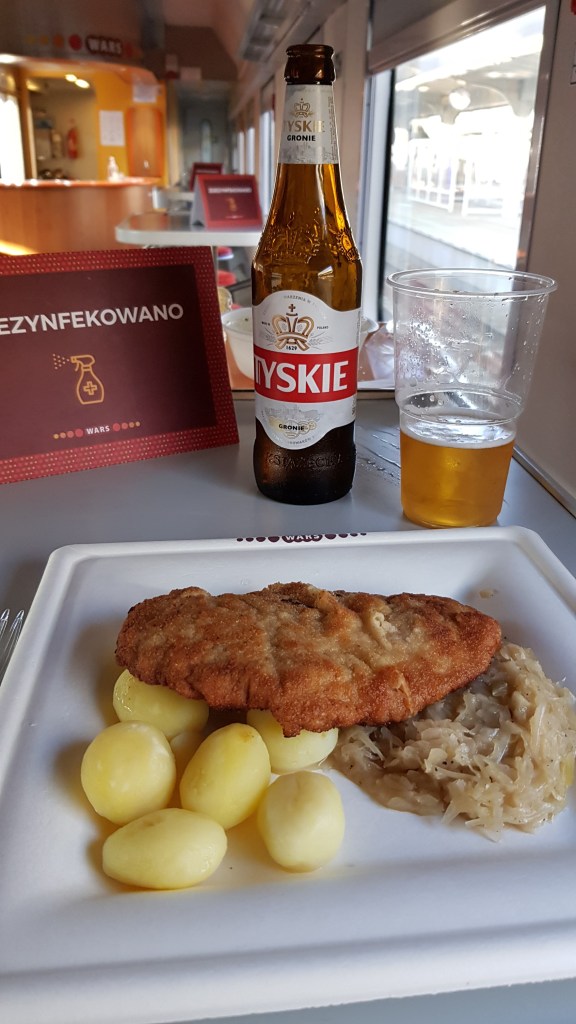
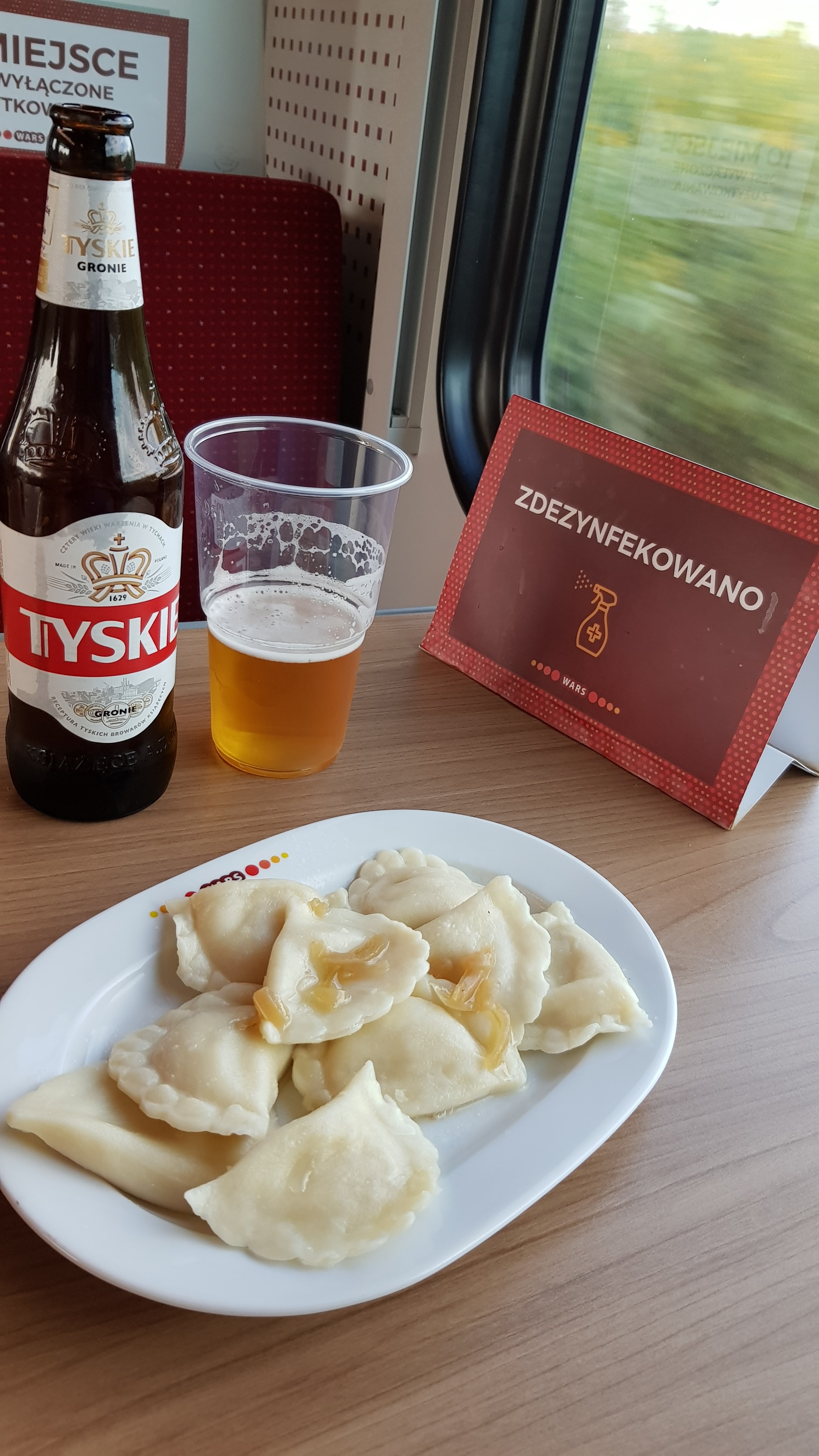
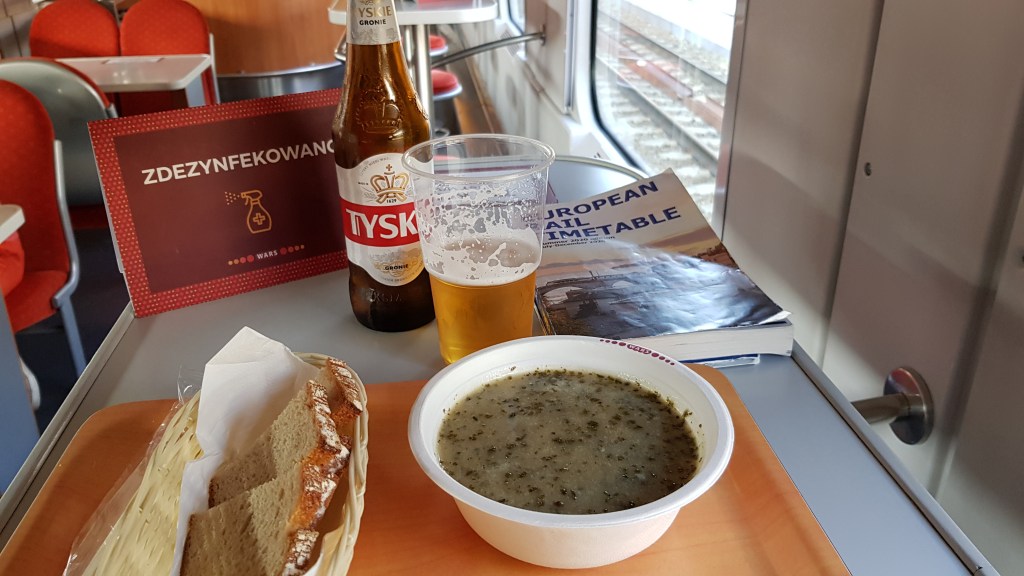
What the train lacks in speed it more than makes up for in comfort. Seating is in either open-plan coaches, or Harry Potter style compartments, and a full catering service is provided by the legendary Polish catering company, WARS. It’s possible to watch the incredibly boring countryside slide by while enjoying zurek, pierogi, schabowy, or placki – all cooked on board. If you don’t know what any of those are, ask a Polish person. Or just stick the beer (‘Pivo’) – but don’t have too much as you’ll need all your senses to escape from the subterranean Warsaw Central Station.

Although the train conveys also first class seating, I wouldn’t get too excited, as all you get is a bigger seat and maybe some salad leaves in a plastic box with parmesan cheese on the top.

Book a ride on this train on either http://www.bahn.de or the awful http://www.intercity.pl/en/

The ‘Gedania’ (Poznan – Bydgoszcz – Gdansk – Sopot – Gdynia)

This train, departing once a day at 12.37, diverges from the Warsaw route at Poznan to serve the Trojmiasto (three cities) on the Baltic coast. Train facilities and booking arrangements are as for the Warsaw train above.

The ‘Wawel’ (Legnica – Wrocław – Opole – Katowice – Krakow)

Daily at 10.37. This train, newly reinstated after a ten year gap while PKP (Polish railways) polished the rails or something is now back in operation. In terms of facilities and booking arrangements, it’s the same as the Warsaw train above – however it takes an entirely different (and much prettier) route.

The journey to Wrocław takes about four hours, and it’s a further three onwards to Krakow. However it’s a lovely journey – with plenty of excuses to try every dish in the dining car – even the fried cheese…

The ‘Metropol’ Night Train (Wrocław – Krakow – Tarnow – Rzeszow – Przemysl)

The appropriately-named ‘Metropol’ connects Berlin with several European cities, notably Vienna, Bratislava, Budapest, and… Przemysl. This multi-coloured night train is operated by Austrian Railways and splits into three portions, with the Przemysl section the bit we are interested in here.

The train leaves Berlin at 18.43 (so you might make it from Staines that day), and gets to Wrocław around 22.45. During the night it makes calls at Opole and Katowice, and Krakow at 03.45. Now Krakow is a charming city, but not at 03.45, so I’d stay in bed until Rzeszow and double back on a day train!
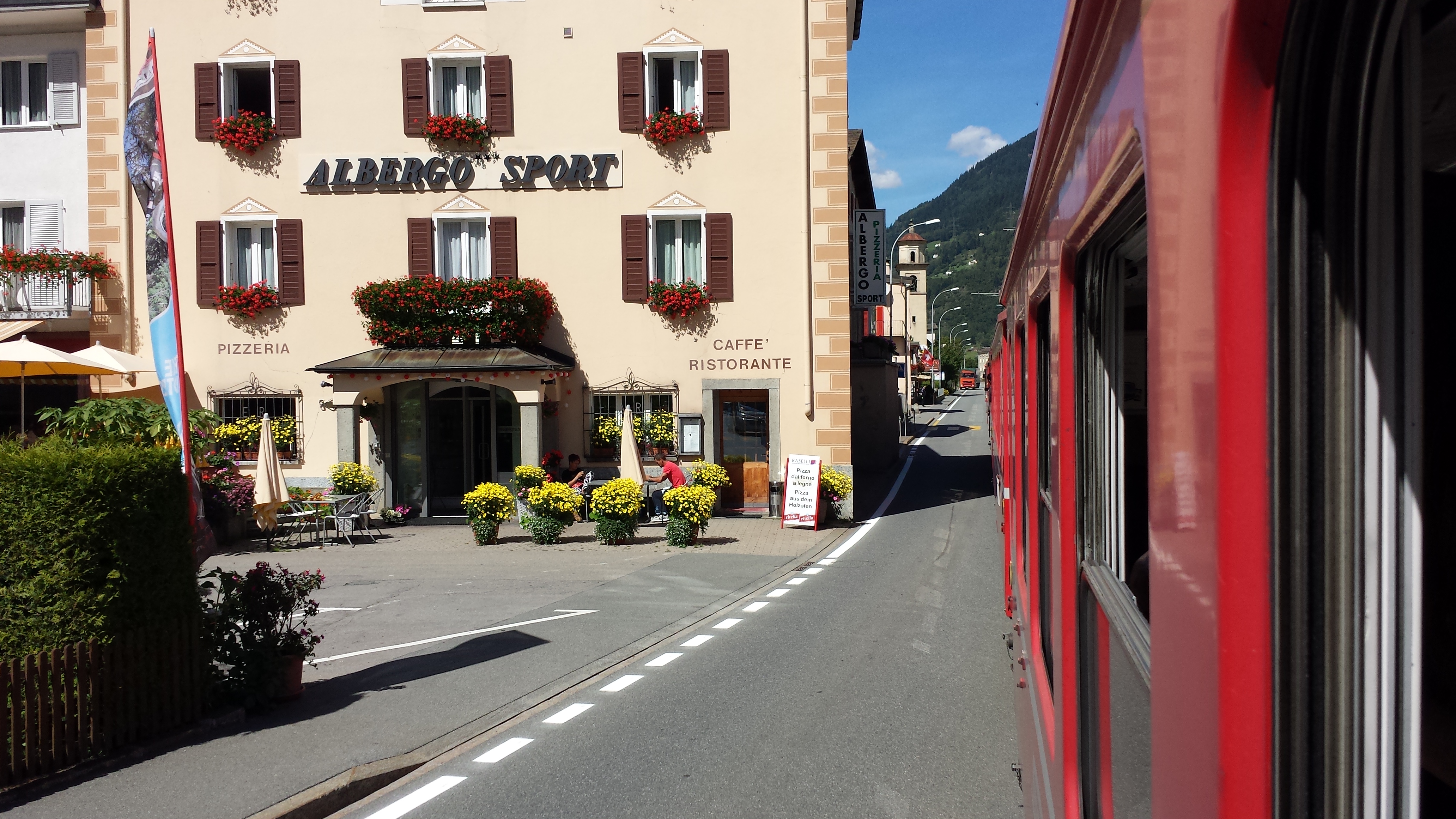
The train will take you in cosy comfort to Tarnow, Rzeszow, and Przemysl – from where easy connections are available to Lviv/Lvov in Ukraine.

There is a seated carriage (six seat compartments) and a sleeping car (very nice…), but no buffet (as people don’t tend to eat when they are sleeping. Book tickets at http://www.oebb.at or if the planets align, at http://www.intercity.pl/en/

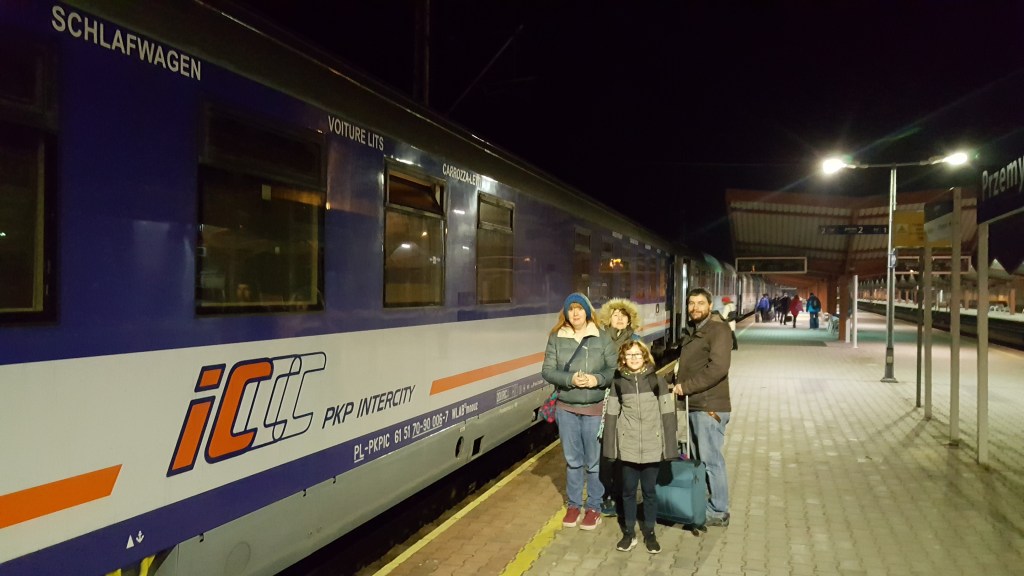
Boarding the ‘Metropol’ from Przemysl to Berlin

Costs and how to book

To price and book a trip like this, you need to divide the journey into three sections, as follows:

1.Escape from Brexit Island.

The journey from London to Brussels or Rotterdam (if taking the ferry) is best booked using the website of the relevant operator – namely Eurostar or Stena Line.

Eurostar varies in price. Expect to pay £50 – 100+ for a single ticket. I usually get one for around £70.

For the ferry, you can book one ticket (single or return) to cover the train from London, the ferry crossing, and the metro and train on the other side. On the Stena Line website, https://www.stenaline.co.uk/ferry-to-holland/rail-and-sail book from London to any Dutch/NS station. The price works out a around £55 adult/£27.50 child for the ticket, and you need to book a cabin for £36 (single), £46 (twin), £80-87 (family). It’s actually quite good value as the cabins are lovely.

2. Getting across Germany

This is relatively easy – simply go to http://www.bahn.de and book a ticket from either ‘Brussels Midi/Zuid’ to Berlin, or (if using the ferry) from Schiedam Centrum to Berlin. Expect to pay between 49 – 99 euro, depending on availability. Usually children under 15 travel free with parents/grandparents, if specified at time of booking. This is why rail travel can sometimes work out cheaper than flying.

Try searching for ‘Brussels/Schiedam’ to your Polish destination. Occasionally a cheap through fare will be available – if not, book to Berlin and go the next step…

3. Pociąg do Polski (train to Poland)

Generally (though see above) the Polish leg is best booked separately.

The obvious place to book is the http://www.intercity.pl/en/ but beware that this is not the easiest website to use. Take a deep breath several times, and beware that it closes each night about 22.30 UK time so that the computer can sleep. It is, however, the official website of Polish Railways (PKP) Intercity.

Alternatively, visit to http://www.bahn.de and make a new booking for the Polish leg only. Some destinations are available, but for others you’ll need to deal with the PKP website.

If taking the night train ‘Metropol’ the easiest place to book is the Austrian Railways website http://www.oebb.at

Conclusion

So, as you can see, travelling by rail to Poland is easy, pleasant, and above all, an adventure. No one is claiming it is fast or cheap, but for a lot of reasons it can still be the best option. Why not give it a try once we are free to travel once more? Please feel free to contact me for any help or advice. Also, don’t forget to visit my favourite website http://www.seat61.com as it will tell you the same as I did, but in better detail!

Lockdown travel series – Part 5: Destinations in Central Europe

Actual destinations – Central Europe

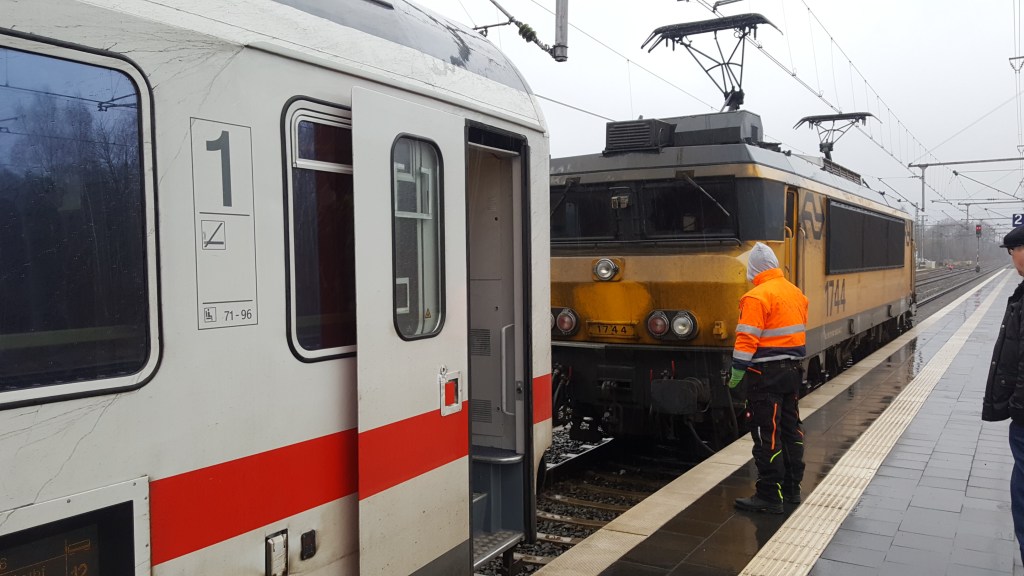
Express to Berlin – At Bad Bentheim, the Dutch locomotive is removed and replaced with a German one.

In my last installment, I wrote about some interesting destinations (or rather ‘stopovers’) that are easily accessible via the Eurostar terminal at Brussels and are suitable for a short break of 5 days or so. Now, let’s have a look at some locations further afield. It’s possible to visit them all on one long trip, or just to pick two or three.

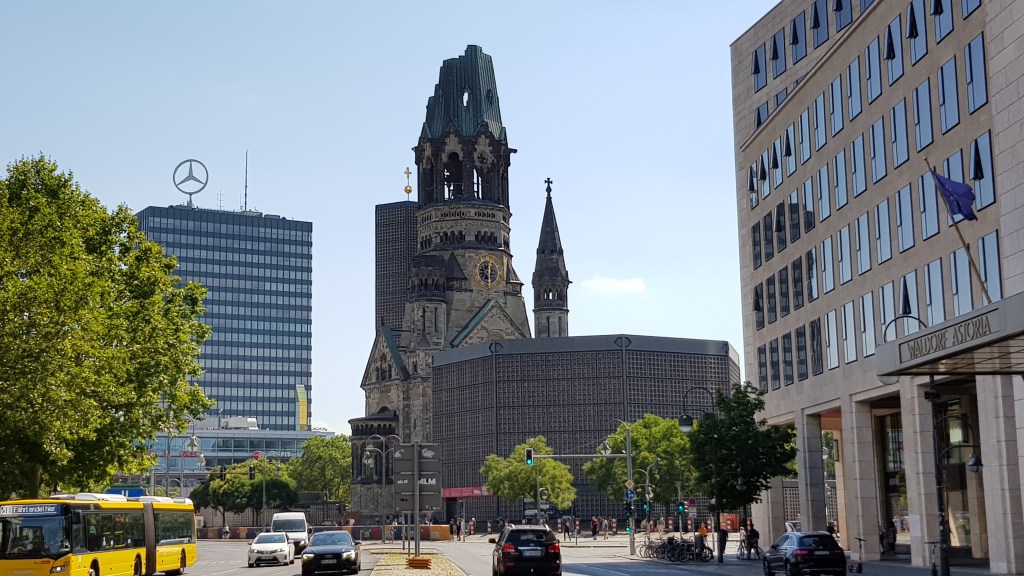
Berlin

Berlin

Heading east from Brussels or the port at Hook of Holland, a couple of changes of train will have you heading to Berlin…

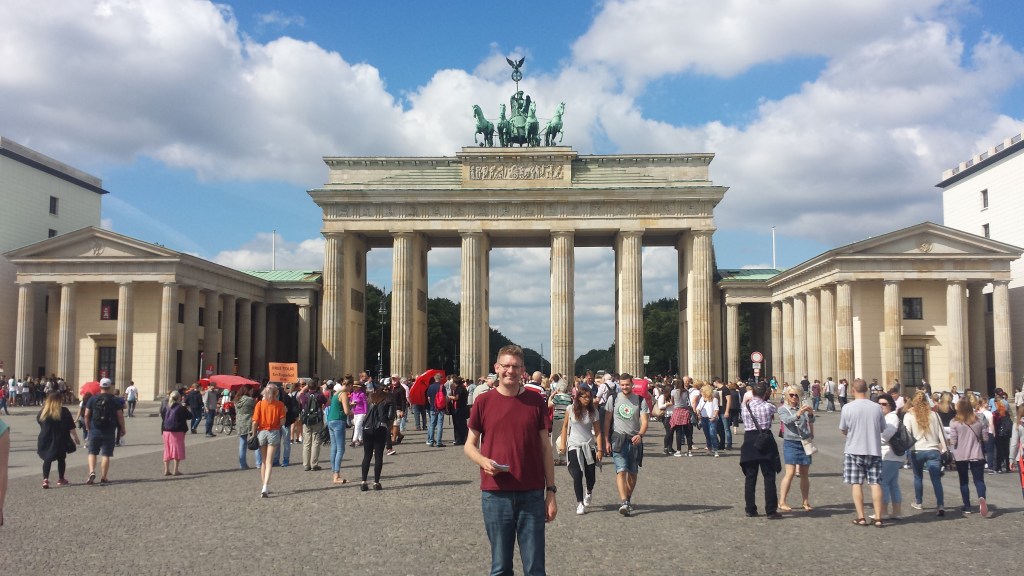
Berlin might be a well-known world capital, rather than a quaint ‘off-the-beaten-track’ kind of place, but it’s a place with both a fascinating history and an ever-changing present. There is simply something for everyone – whether you like shopping, clubbing, history, railways, architecture, or the arts. Like London, Berlin has no single obvious city centre, but several districts each with their own character. Even if you’ve been to Berlin before, it is always worth a night or two. It is also a useful transport hub for some of our other destinations.

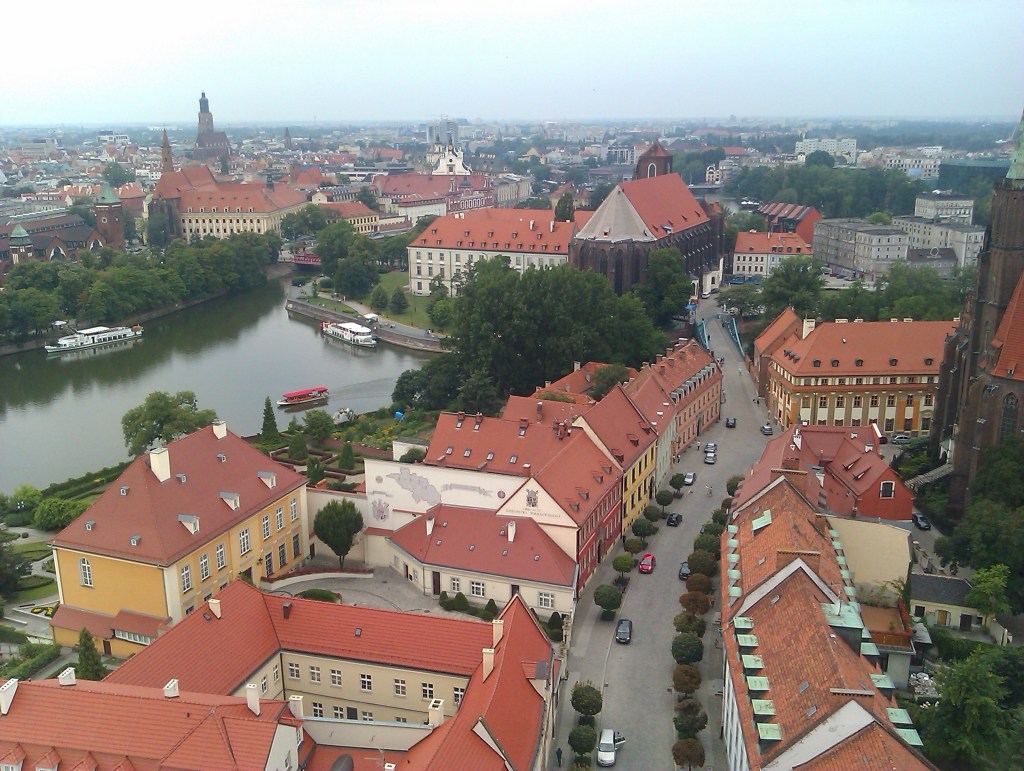
Wrocław

Wrocław

Poland is a bit like Italy, in that it is packed with interesting places to visit. Krakow and Warsaw are the places most visitors head towards, and you’d not be making a mistake to go there now. Almost everyone in our parish community knows or is related to a Polish person – so it’s easy to get information and recommendations about where to visit and (most importantly) what to eat.

However one city stands out, and that is Wrocław, in the south west of the country. With two daily trains from Berlin, each taking around 4 hours, it is an obvious place to stop. Like Krakow, it’s full of historic buildings, beautiful churches, charming streets, and amazing city squares – but it also has a railway station you can actually get out of.

Regular trains link Wrocław to Krakow, so it’s easy to combine the two – not least because Krakow is better placed for onward connections.

Into Czech Republic

The train journey from Wrocław into the Czech Republic involves varied routes and several changes of train, yet the reward is some beautiful scenery – unless you take the overnight train, that passes through a corner of the country at 2 am and has no rewards at all. In contrast, there are direct and convenient day and night trains into Czech from Krakow.

If you see a Czech train with a dining car, get on it – even if it’s not going in your direction.

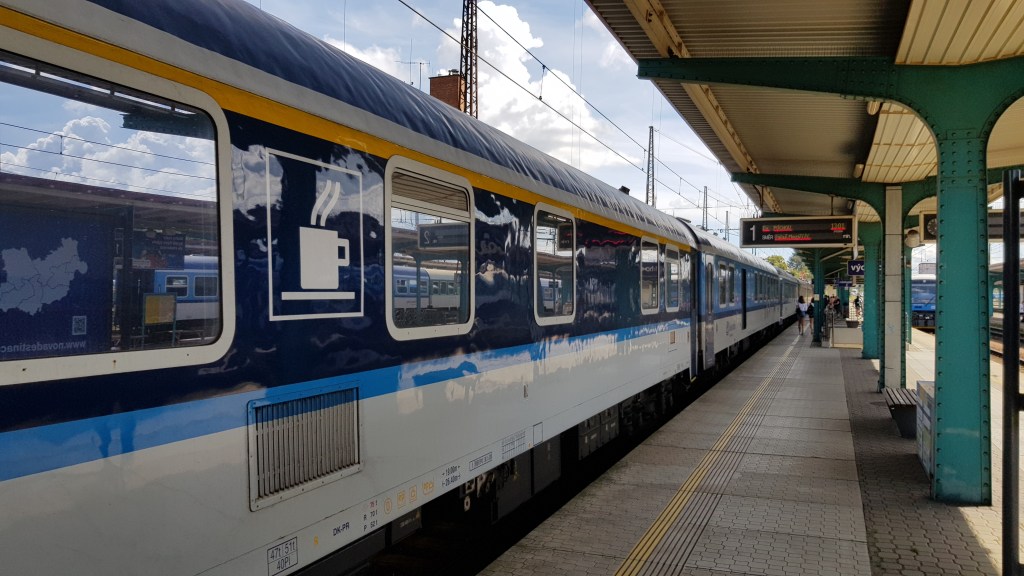
From Berlin, a very nice two-hourly ‘Eurocity’ service with Czech restaurant car (schnitzels, dumplings, beer, very good value) runs via Dresden (itself worth a stop) to Prague. Incidentally, if you see a Czech train with a restaurant car, go on it, irrespective of whether or not it’s going in your direction.

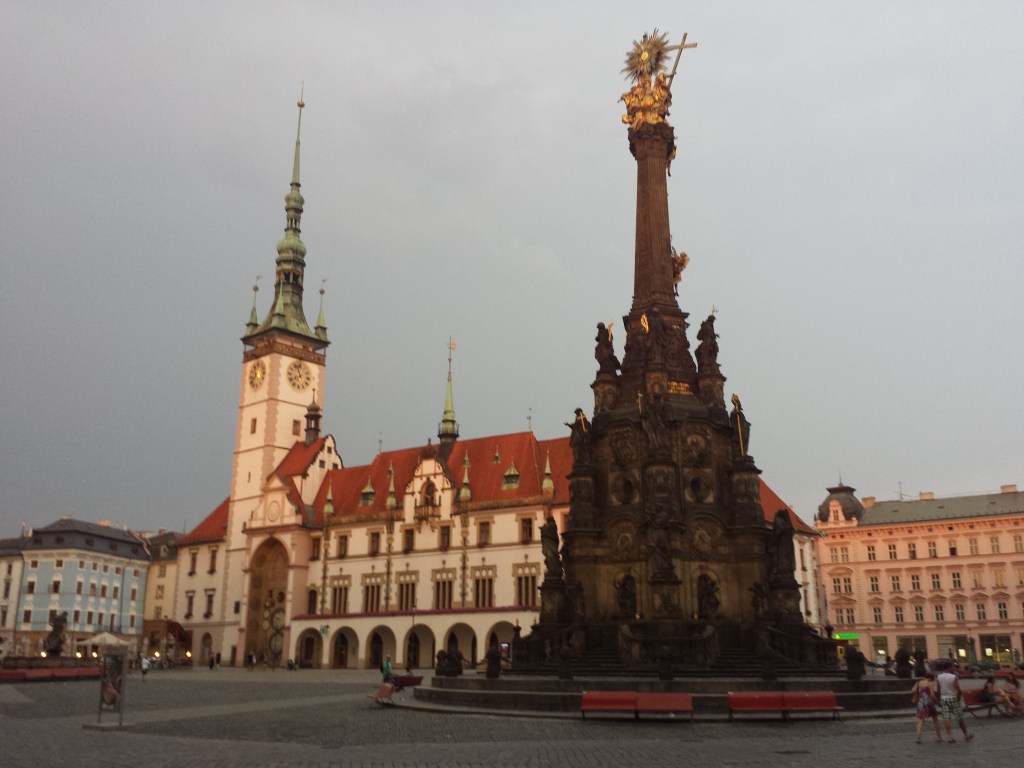
There is a lot to see in Czech – with some of my favourites being Brno, Olomouc, and Plzen – all nice old towns full of atmosphere – and beer.

Olomouc

Just south of the Polish border is some particularly charming countryside and small towns in the valley of the River Orlici – easily reachable from Wrocław.

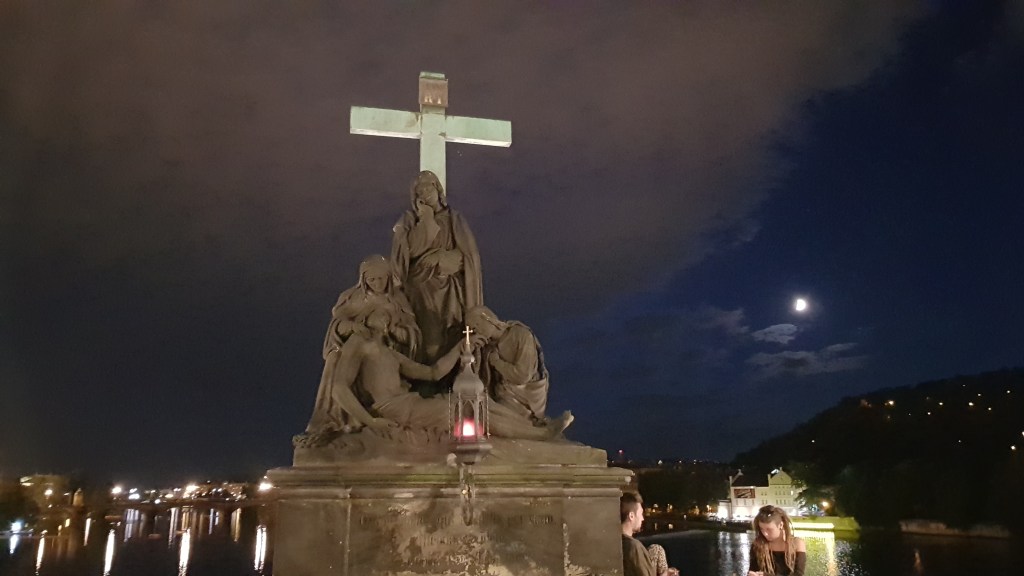
Most people have heard of Prague – and usually it feels as if most people are there whenever you visit, especially on the famous ‘Selfie Bridge’ in the city centre. However, there is a lot more to the city – and in particular the fantastic connections available from the main railway station.

Prague – The famous ‘Selfie Bridge’

Onwards to Slovakia

Every night a suite of overnight trains run from Prague to the charming Slovak city of Kosice.

There’s the regular service, run by the state railways, fairly cheap, comfortable, and with a range of accomodation options – but no dinining car.

There’s the privately operated ‘Regiojet’ service, with flowers in the loos and at-seat sushi. However, the beds are a bit hard and I’m not sure the sushi makes up for that.

Finally, there’s the ‘secret sleeping car’, which leaves Prague attached to a train with a dining car, get switched between other trains as you sleep, and arrives bright and early. This would be my preferred choice.

Kosice

Kosice is Slovakia’s second city and a convenient stop en route to Ukraine. But let’s leave that for another time.

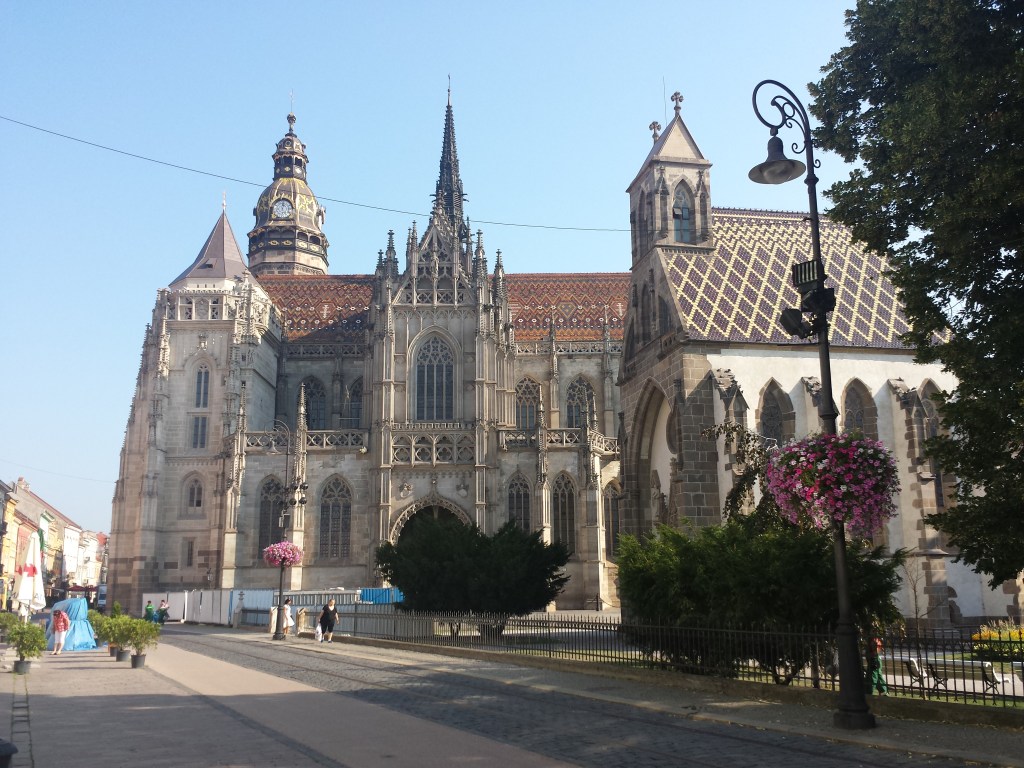
Kosice has several interesting features, including a Disneyesque main street, a beautiful Cathedral, a bell tower with views accross the city, some more old churches, a lots of quaint streets, some nice restaurants and cafes (including one that seems to only serve chocolate), and, usefully, an outdoor swimming pool. The latter comes in handy, as a it’s close to the station and so a good way of cooling down on a hot day. Kosice is also a good base for exploring the surrounding area.

Kosice

Poprad and the Tatra Mountains

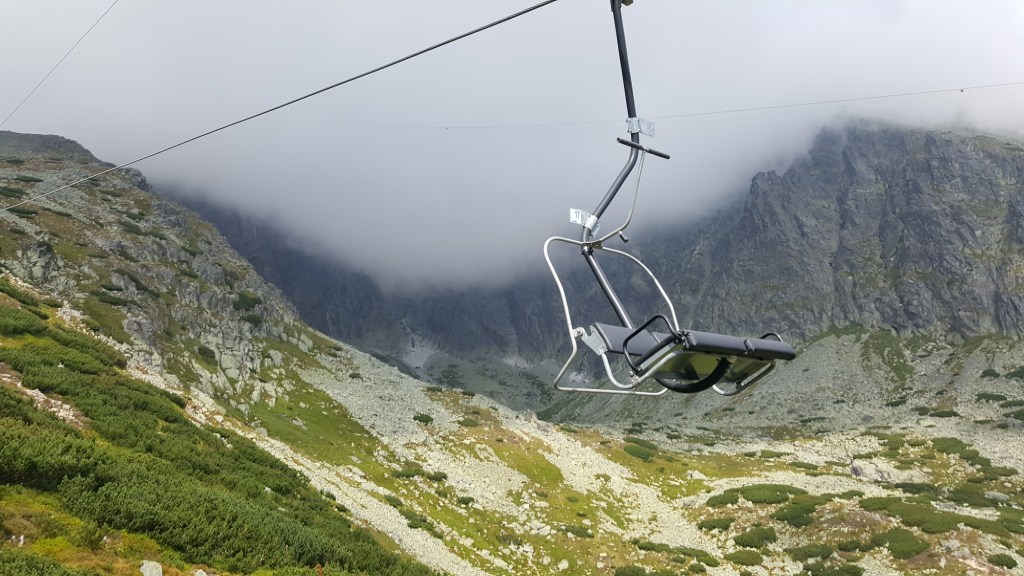
The Tatras span the border between Slovakia and Poland – and also make travel between the two more difficult at this point. Both sides have their own mountain resorts, ski facilties, and walking trails. Arguably the Slovak side has the edge, as it has the best rail and cable car links, and the beer is cheaper. Poprad, on the main Kosice – Bratislava railway, is the main transport hub, and also boasts the amazing (and rather expensive) Aqua City pool resort.

High chair in the High Tatras

Trencin

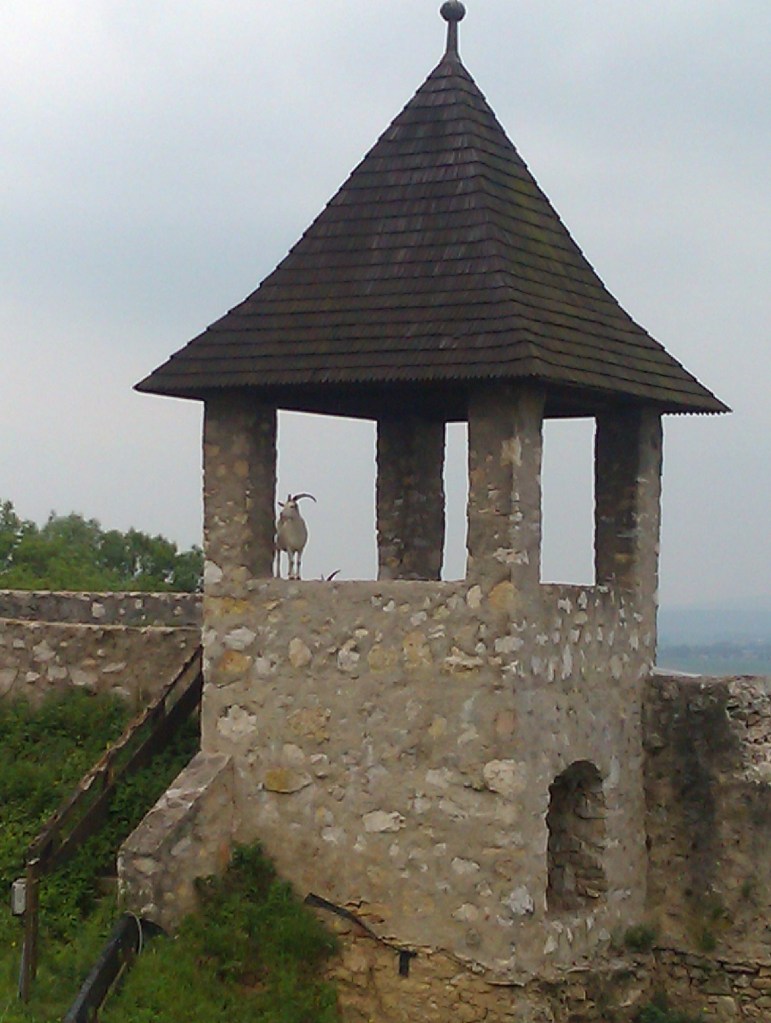
The regular Kosice – Poprad – Bratislava train also calls at a nice town called Trencin. With it’s hillside castle and quaint old town, it makes a good spot to spend the night.

Trencin Castle

Bratislava

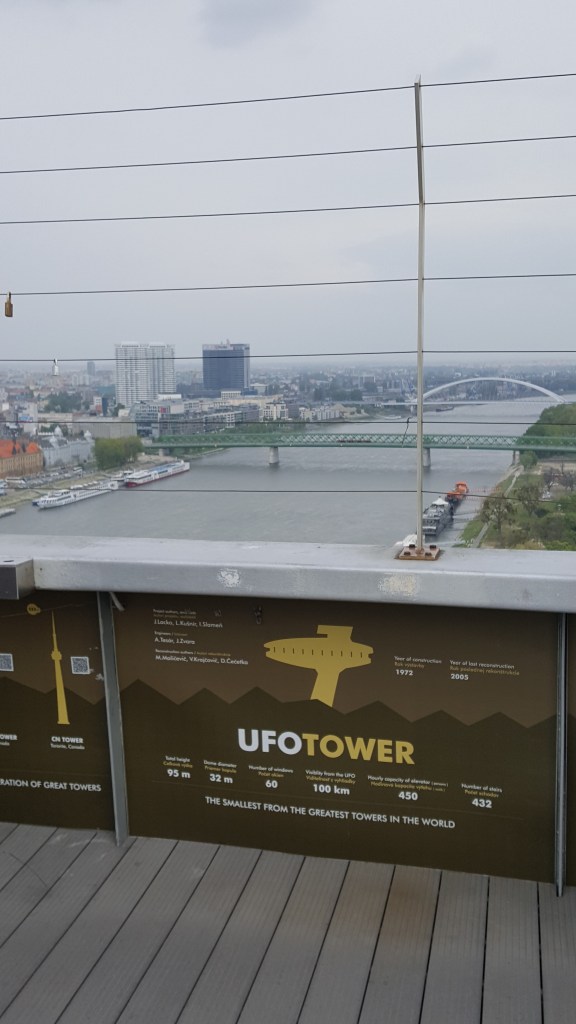
Bratislava isn’t exactly in the same league as Prague or Krakow, but in some ways this is an advantage, Accomodation is relatively cheap, the city is lovely to walk around, and it’s a good base for a day trip to rather more expensive Vienna. Trains between the two cities take just under an hour. While in Bratislava, there are fantastic views from the castle and also from the ‘UFO Bridge’, which is topped with what is claimed to be ‘the shortest high building in the world’. Well worth a visit.

Over the border into Hungary

Most regular trains from Bratislava to Budapest feature an excellent Czech or Slovak restaurant car. You would be silly not to avail of it. Why not try the chocolate-filled pancakes this time?

Sit on the right-hand side for the best views, which largely come after leaving Slovakia.

Budapest

Others can tell you about Budapest, so I won’t – suffice to say that, like with Berlin, it rewards repeated visits. A trip to one of the thermal baths is always worthwhile – the Szechenyi baths would be my favourite.

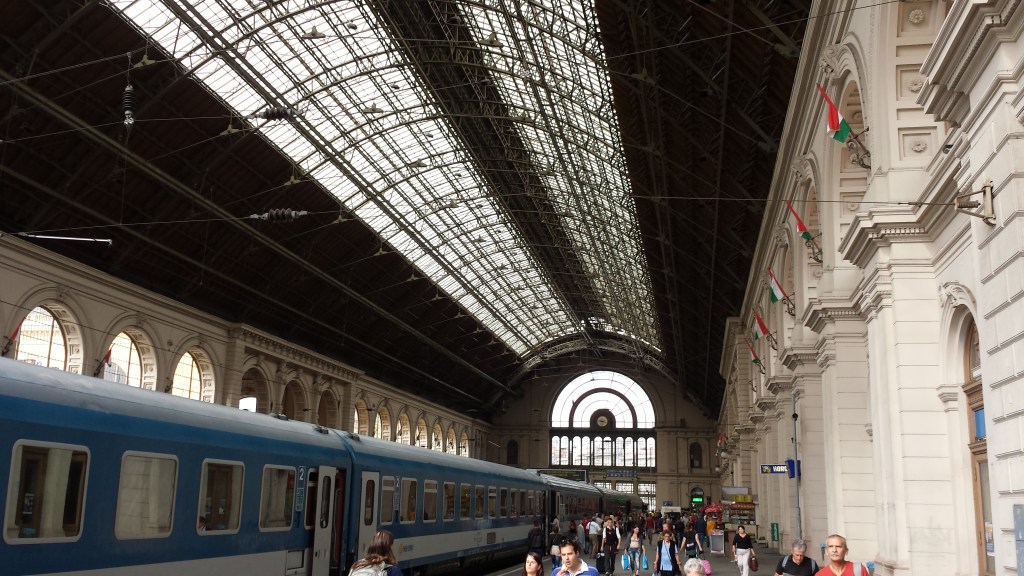
Budapest Keleti station is probably where you’ll be headed to, and from this grand temple of faded glory, even greater adventures await – next time…

Budapest – Keleti Station

Lockdown travel series – Part 4: Destinations beyond Brussels

Actual destinations – Beyond Brussels

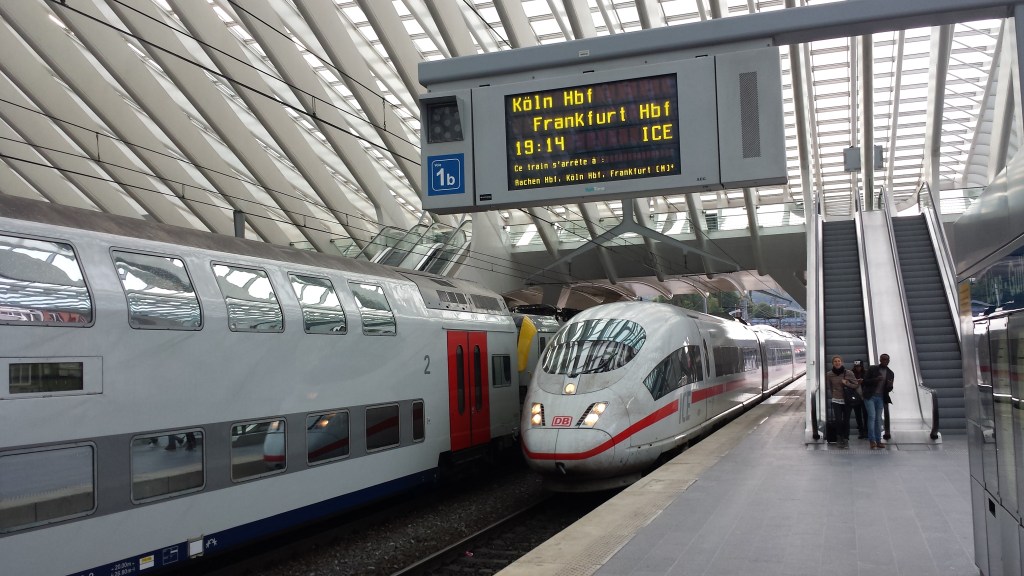
The ICE train from Brussels to Frankfurt, via Aachen and Cologne

Not so far away

The most obvious place to travel to is of course the continental Europe – or, as I like to call it, the mainland.

When you think about Europe, you probably think of places like Paris, Amsterdam,Rome, Prague, and Madrid. These are of course excellent places to visit and I’d choose any one of them over a night at the Staines Premier Inn any day, but there are other places too – towns and cities that may not be world capitals, but are still worth a night or day en route.

Let’s have a look and see what we can see…

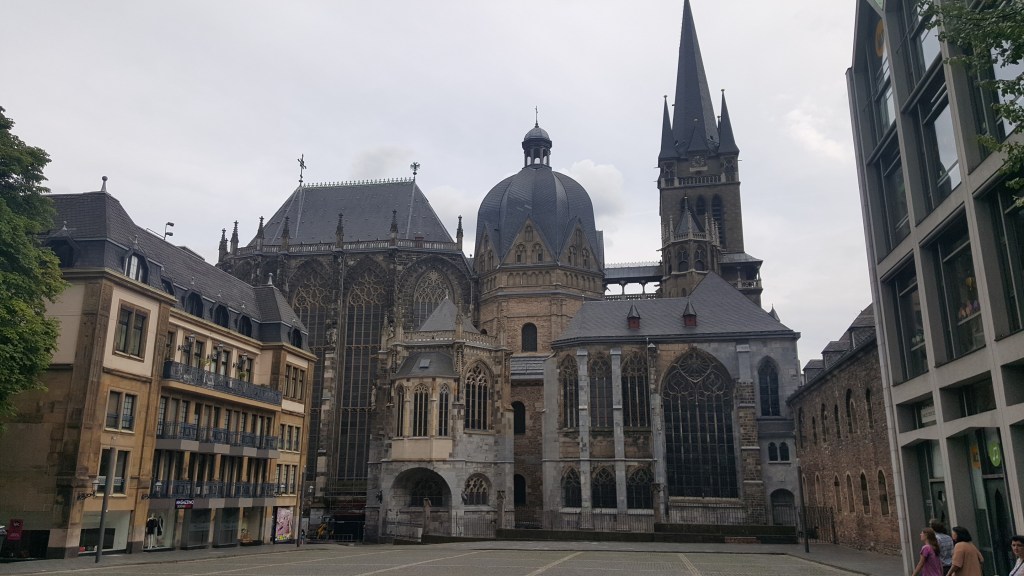
Aachen Cathedral

Aachen, Germany

A German city just over the borders of both Belgium and Netherlands that was once the seat of the Emperor Charlemagne. His (rather uncomfortable) throne can be found in the upper gallery of the ‘Dom’ (Cathedral). Aachen is a nice place to stop overnight en route east from Brussels, perhaps before continuing next day towards Berlin. A couple of decent ‘Ibis’ hotels add a cherry to the top of this tasty cake of a town.

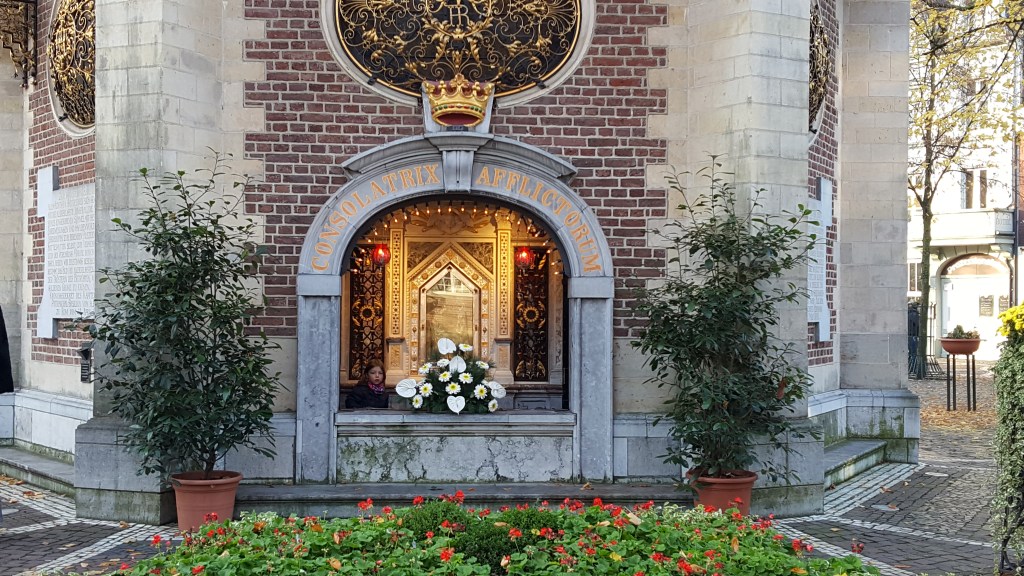
Kevelaer – The Chapel of Grace

Kevelaer

You won’t stumble across this quaint little pilgrimage town by accident, as it’s half way up a branch line from nearby Krefeld (a city once known as the murder capital of Germany). However there are few murders in Kevelaer, which is not surprising as it is one of Germany’s two most famous Marian shrines. The town is packed with churches, two basilicas, and a cute little chapel containing the miraculous image of Our Lady of Luxembourg. Quite what the association is with Luxembourg nobody seems to know, but why not mull it over with kaffee und kuchen at the famous ‘Cafe Heilen’ Konditorei?

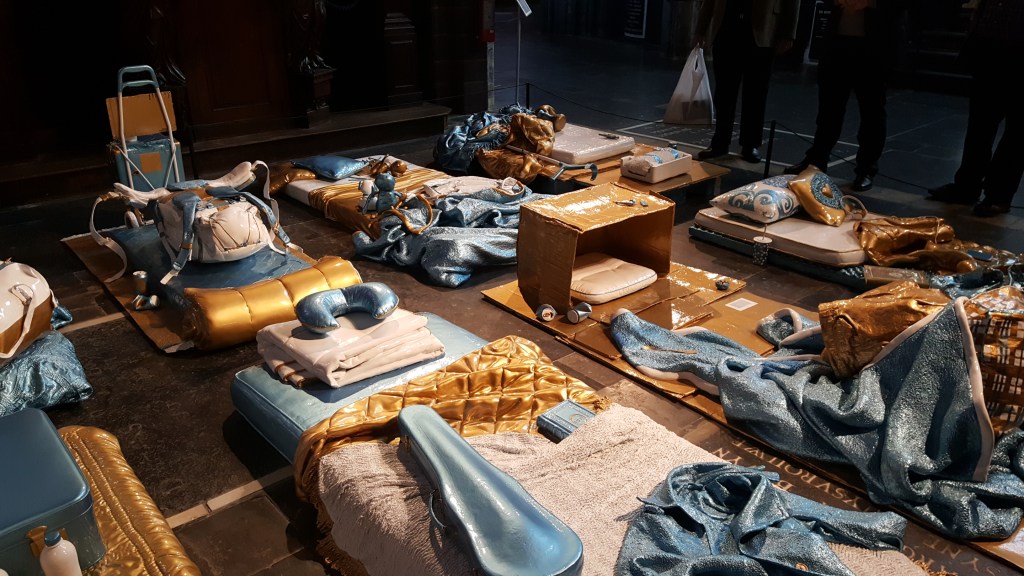
Antwerp – Art installation in the Cathedral

Antwerp

Bustling, industrial Antwerp is one of Europe’s key port cities – but it’s also a fine port of call for rail travellers. Regular trains link Antwerp with Lille, Brussels, and destinations in the Netherlands. Antwerp is one of the key global centres of the diamond trade, with as much 80% of the world’s rough diamonds passing through, and spending their evenings in local bars.

The diamond quarter is close to the monumental rail station – which is itself one of the city’s main sights. The Cathedral, packed full of works of art both new and old is worth a visit – not least for a cup of tea in the ‘Sacristy Cafe’. The old town is full of charm, and if you do go, I wouldn’t mind some homemade treats from ‘Philip’s Biscuits’ in the city centre.

Phantasialand

Phantasialand

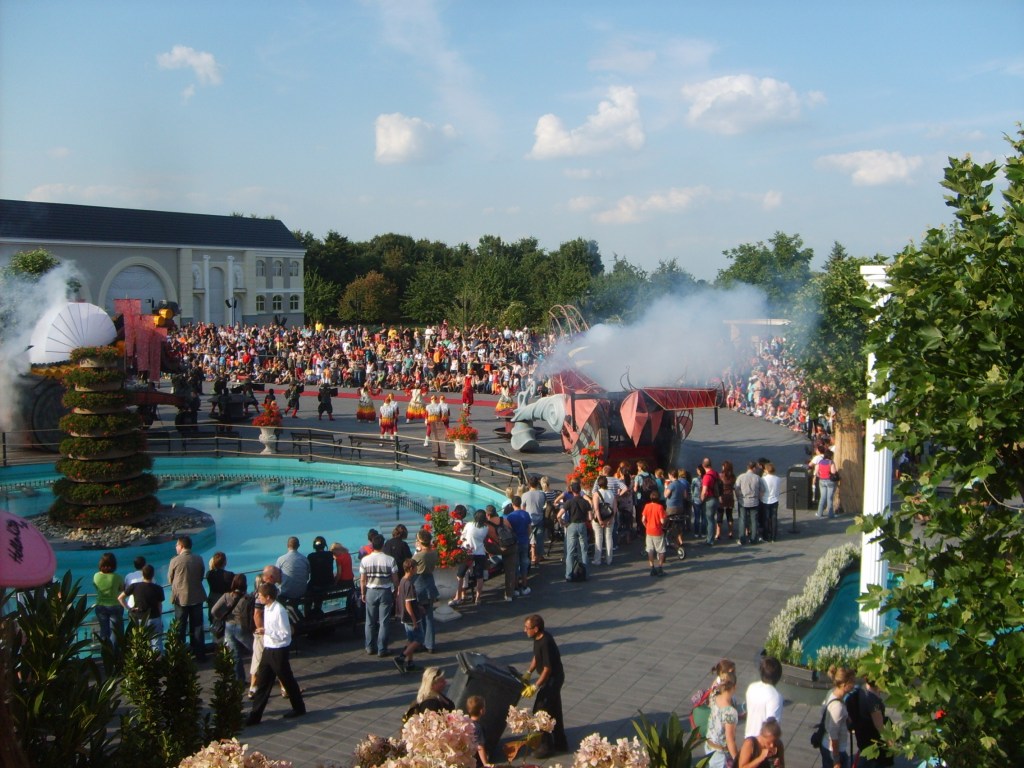
Imagine Disneyland, Thorpe Park, and Blackgang Chine all rolled into one, and you’ll have a rough (well, very rough) idea of what Phantasialand is like. The theme park, a short bus ride from Bruhl station (a few stops south of Cologne) is perfect for primary school age children and their families, with everything from a Disney-style ‘main street’ to a on-the-verge-of-terrifying rollercoaster set in the wild-west style gold mine. It’s obviously a gold mine for the owners too, as you’ll see from the admission charges. But still, it is worth a visit.

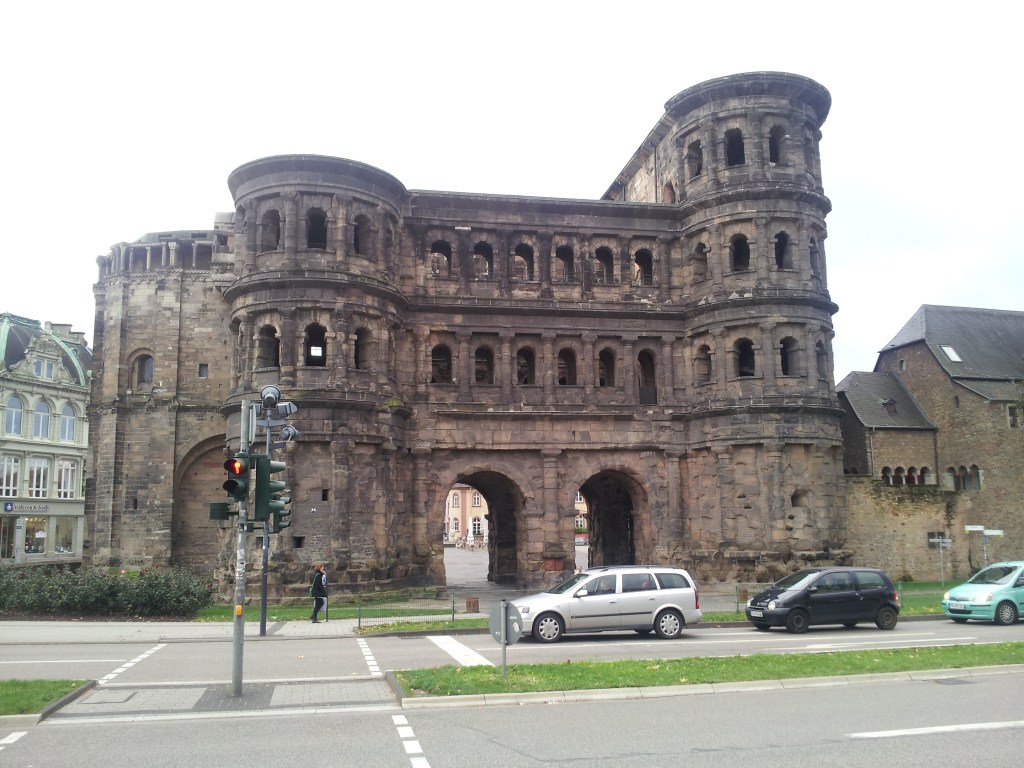
Trier – Porta Negra

Trier and the Mosel valley

I’ve not mentioned Luxembourg yet, as this city of banks and go-go clubs is mainly of interest as a transport hub. An hourly train from Brussels will connect here with the local train over the German border to Trier, an ancient Roman settlement on the banks of the River Mosel. It’s a lovely place, with the Roman Porta Negra being one of the key monuments, but after a night or day, it’ll be time to head further up the Mosel valley, perhaps stopping for lunch in the picturesqe town of Cochem, before joining the Rhine valley at Koblenz.

From Koblenz you can then either head north to Cologne (and Phantasialand) and then via Aachen back to Brussels – or you can go south down the scenic Rhine valley line, stopping in other pretty little towns or heading fast to destinations further afield.

In my next installment we will go a little further…

Lockdown travel series – Part 3: Online resources

In my earlier work, dear Parishioners, I dealt with everything concerning the paper resources (maps, books etc.) that are handy, if not necessary for planning a good journey. I explained that is a good idea to use a mixture of paper and online resourcesSo this section, we will be looking at some of the various online resources:

Online travel resources

As you no doubt guess, I love maps and books and, most especially a good timetable! These are indispensable tools both for planning and while ‘on the road’ – and online resources cannot easily replace them. However, there is a place for apps and websites and other such things – as you will see:

The Man in Seat 61

There are very few words to describe the excellence of this resource. The ‘Man in Seat 61’ is actually a man called Mark Smith, a former railway manager who is probably the world’s most famous rail travel blogger and campaigner.The website is engaging, informative, well-illustrated, and above all, accurate (or at least as accurate as possible).

There are sections for pretty much every country in the world that has a rail network, with descriptions of how to get around, buy tickets, and what to expect the train and journey to be like. Most country sections include full details of how to get there by rail from the UK, which is to be expected for much of Europe – but comes as a rather more of a surprise when it comes to reaching Indonesia or Tibet!

I have listed this website first, because it is the first and most inspiring online resource to visit. Visit the ‘Russia’ section as a good first introduction!

The ‘Man in Seat 61’ also has a Twitter account and Facebook page, both of which are worth following.I am not going to list links to rail operator websites – as the ‘Man in Seat 61’ can do a much better job of it than me! http://www.seat61.com

Deutsche Bahn (German Railways)

German Railways is probably the largest and busiest railway in Europe, its tentacles extending even to the UK, where it has owned several rail companies and a freight business. However within Germany its reputation is, how shall I say, not so strong.People often say that German trains are ‘always on time’, but in my experience they are always late, the train is in reverse formation, the air-con doesn’t work, and the buffet is not selling hot food, cold drinks, or both. However on the rare occasions that the planets align properly, you can enjoy a pleasant and fast journey, on a sleek and comfortable train, whilst eating spare ribs washed down with a draught Bitburger.

But it is their online resources that interest me here.

The www.bahn.de website is a great if sometimes quirky resource for booking travel to, from, or through Germany – and some of the good-value fares warrant a whole chapter of their own. However, it is the timetable planning function that is most useful – as you can plan a journey from Staines to pretty much any station in Europe and any address in Germany.

Additionally the ‘DB Navigator’ app is good for planning, booking and getting informed about a journey while en route.

booking.com

There are plenty of hotel booking websites around, but I’ve found this one to be the easiest to use. It needs little explanation, other than to say that, while it is easy to be seduced by cheap non-flexible room rates, it’s usually a better and safer idea to go for a more flexible option. Remember what I said about not hard-wiring your itinerary…

Skyscanner

Why would I be recommending a flight search website? Simply because there are some places it is not so easy to get to without squeezing on a place, such as America. Also, while it is arguably better to avoid flying altogether on journeys around Europe, the reality is that Heathrow is our major employer here in Staines, so we might want to keep it going…

It is worth playing with dates, airports, and via points to get the best fares – and then the site will direct you to a ticket provider. Beware, however, the app is largely an annoying waste of time – use the desktop version of the website for the best experience.

Google Maps

Google maps ‘is what it is’. It eats your data and battery power, but it invaluable for navigating unfamiliar places. Public transport information varies from region to region. In some places it is accurate, while in others it is patchy, incomplete or unrealistic in its journey suggestions, and in some cities such information is non-existent. It is also not uncommon for hotel or other attraction to be in a completely different location. So just double-check.

CG Transit

CG Transit is a smartphone app that you pay an annual subscription to use. Once downloaded, and updated from time to time, it works off-line, i.e. without an internet connection. The app includes rail schedules for most of Europe, bus schedules for Czech and Slovakia, and features handy little maps and easy to understand journey plans. Use this in conjunction with the European Rail Timetable and you’ll be able fly around Europe like a shark.

Vagonweb

A rather more ‘niche’ resource is the excellent www.vagonweb.cz The fact this is a Czech website is no coincidence, because in my opinion, the Czech railway network is probably the best in Europe, and what Czechs don’t know about railways is nobody’s business. The stylish dining cars with delicious food cooked by an onboard chef, the comfy passenger facilities, and the bargain fares make for a country that is as close to heaven as is possible this side of the grave. Whatever it was that German railways somehow lost in the last twenty years – well, it seems to have ended up in Czech.

Anyway, you wanted to know about Vagonweb… This website tells you everything you need to know about the most important part of the train, the vehicle you will actually be sitting in – and, crucially, whether or not there might be a buffet car. Simply select your country and train number, and in a series of pretty pictures, all will be revealed.

Enough for now

So, that enough online resources for now – and enough focus on planning. In my next installment we’ll look at another important aspect of travel – where exactly you might actually want to travel to.

Lockdown travel series – Part 2: Printed resources

This series is updated and continued whenever I fancy a break from ‘parish things’ – such as late at night or on my day off…

Planning Resources

As I said in my last post, the function of planning is not to hardwire you into a rigid and unchangeable itinerary, but to enable more, not less, spontaneity. The best adventures are the ones that do not go as originally planned.

This installment focuses on the resources that can make this planning possible.

Paper or Online?

My first experience of extensive travel was in the mid 1990s. Back then the internet was a niche attraction and you had to rely on guidebooks, printed timetables, and maps. In 2021, it is possible to do away with all of these things and to rely entirely on a mobile phone. Back in the 90s, the only electronic device I carried was a travel kettle – but nowadays traveling without a mobile device is well-nigh impossible.

The whole ‘online thing’ does not mean that paper and printed resources are unnecessary, as for the best experience you really need a bit of both.

Paper resources

These are most necessary when beginning to dream and to plan – i.e. now. Yes now, in lockdown. Nothing quite stirs the imagination like a map or a book.

Guidebooks

When I first started travelling, I would carry a whole mini-library of Rough Guides and Lonely Planets. They would weigh a ton, but were an indispensable companion. I remember losing one such guide in Kiev – and seriously considering stealing an identical copy from the guy in front of me a queue – so lost did I feel without it. Google means that such heavy lifting is no longer necessary, but guidebooks are invaluable at the planning stage. Good quality guides, such as Lonely Planet, Bradt or Trailblazer, are incredibly well-researched, engagingly written, and give some of the local and historic context in a way that Tripadvisor doesn’t. The highly pictorial ‘DK Eyewitness’ guides are not so strong on practical details, but are a great way of feeding the imagination.

Another good book for ‘dreaming’ is ‘Europe by Rail’ by Nicky Gardner and Susanne Kries. It’ll give you an idea of both where to go and how to get there. It even has a website https://www.europebyrail.eu/

In addition, as not so many people buy guidebooks any more, by purchasing one, you are supporting a worthwhile sector, and those who write for them.

Maps

Google Maps is great when you are lost, but nothing beats a paper map, both when planning and on the road (or rails). You can visually explore an area, consider alternative routes and destinations, and generally get a feel for the place you are exploring, or planning to explore. A map is also a far valuable keepsake than any expensive souvenir. Especially when it is marked with your route, and stained with local food and drink.

The most useful map of all is the ‘Rail Map Europe’, produced by the publishers of the European Rail Timetable (see below). It’s a handy size, with just the right level of detail. Trying to explore Europe by rail, without a such a map, and without an idea of where trains actually go, can be frustrating. So I’d get one, if I were you.

For detail on specific countries or regions, I like the’Marco Polo’ series of maps.

For city or local areas, there’s not much wrong with the various free maps available from hotels and tourist offices. They also make a great souvenir.

Timetables

Many people are scared of timetables – after all they can look confusing with all their symbols, codes, and footnotes. In many cases, there are so many apps and online journey planners that seem to make paper timetables unnecessary. But not so soon…

The problem with apps and other online resources is that while they are fine for planning one journey to one place at one specific time, they are not so good if you simply want to explore or check out how easy or not it is to get around. They give you a focused, tunnel vision on one particular connection/itinerary, but no picture at all of ‘where trains go’ or the level of service provided.

In contrast, a timetable gives you, at a glance, the full picture. At barely the flick of the page you can find first and last trains, get an idea of frequency and journey time, and see which routes are actually worth taking.

Unfortunately, many operators no longer provide such timetables, which means that the following product is pretty much a necessity…

The European Rail Timetable

This really is ‘the bible’ when it comes to travelling around Europe – and also overseas. Published several times a year, it provides rail and shipping schedules for the whole of Europe, Turkey and the former USSR, and selected editions cover other parts of the world. It was originally known as the ‘Cook’s Continental Timetable’, as it was published by the legendary Thomas Cook, until just before that outfit’s demise. The timetable is now produced independently by a team of experts for whom rail timetables are their religion – and this comes across clearly when you open the book.

It’s the only publication that will allow you to plan a journey from Staines to Shanghai by rail, or even from Killarney to Kiev. I have bought this timetable at least twice a year since 1995, and now I have an annual subscription! It is a good idea to order the special Winter or Summer editions, as they include worldwide coverage, and various traveller-friendly tips.

Now you might be wondering if I get commission for encouraging you to buy this book – but I don’t! However in current times, the future of my ‘travel bible’ is far from certain, so if you get one now, not only can you explore future trips, but you’ll make sure that I can too!

If you want to get one (and perhaps the ‘Rail Map Europe’ too), here’s the link: https://www.europeanrailtimetable.eu/

In my next installment (perhaps after the weekend) we will look at online resources. But if I were you, I’d order yourself a map and a timetable, right now in lockdown…

Lockdown travel series – Part 1: Planning

You can’t travel right now, but you can dream…

As many of you know, one of the things I am most passionate about, besides our parish community, is what some might call my ‘obsession’ with travel – and in particular, train travel. While current circumstances might have curtailed this a bit (though not that much – as you might have noticed!), and while there are far bigger problems in our world to worry about, when I get some time off, I usually like to turn to the ‘bible’ (pictured) and dream of faraway stations…

This lockdown period may not be a good time to plan, let alone book anything – but it is a time to dream and maybe consider possibilities. So over the next few weeks, as a break from parish stuff, I’ll try to share some destinations, resources, and travel tips. Maybe you’ll be inspired, maybe you’ll see that, once we can travel again, an adventure is possible for pretty much anyone, of any age, at most budgets! It even works with kids – and even with parents.

The Value of Planning

You might remember the old saying – ‘prior planning and preparation prevents pretty poor performance’. This doesn’t mean you need a rigid itinerary with pre-booked transport and accommodation – in fact too much planning can make for a very boring holiday, as all you end up doing is scrolling through an itinerary that isn’t half as much fun as you thought it would be.

The key is to get a balance. It’s useful to have a rough itinerary, an idea of how to get between locations, and some concept of what you might do in order to eat and sleep. However there needs to be room for flexibility. You might arrive somewhere and not like it very much, you might hear of somewhere else more interesting, or you might find that your one-night stopover in wherever is far better than you could have ever imagined.

The idea of planning is not to hardwire you and your companions into an inflexible programme, but to give you the ability to change plans at will, wisely yet imaginatively.

So my first posts will be about planning – as it sets you free to be spontaneous!

The over the top way to Italy

20140828_150927_Android

This really is a case of the journey being the destination.

It’s possible to wizz from Zurich to Milan in 3 hours 25 minutes, using the new Gotthard Base Tunnel under the Alps. But the views in the tunnel aren’t great. It is much better then to go over the Alps, using the original, much shorter Gotthard Tunnel and the Gotthard Pass. This can be achieved by changing at Arth Goldau and Erstfeld, making a total journey time of 4 hours 40 minutes.

However, the best way of enjoying the mountains is to take the Bernina Pass, which goes higher still, crossing the Alps above the treeline, and then dropping down into the quaint border town of Tirano. This route will take a total of 9 – 10 hours, but is worth every minute of it. The journey starts with the intercity train with Zurich to Chur, which heads south along the shores of the Zurichsee and Walensee, the high mountains reflected in the waters of the lake.

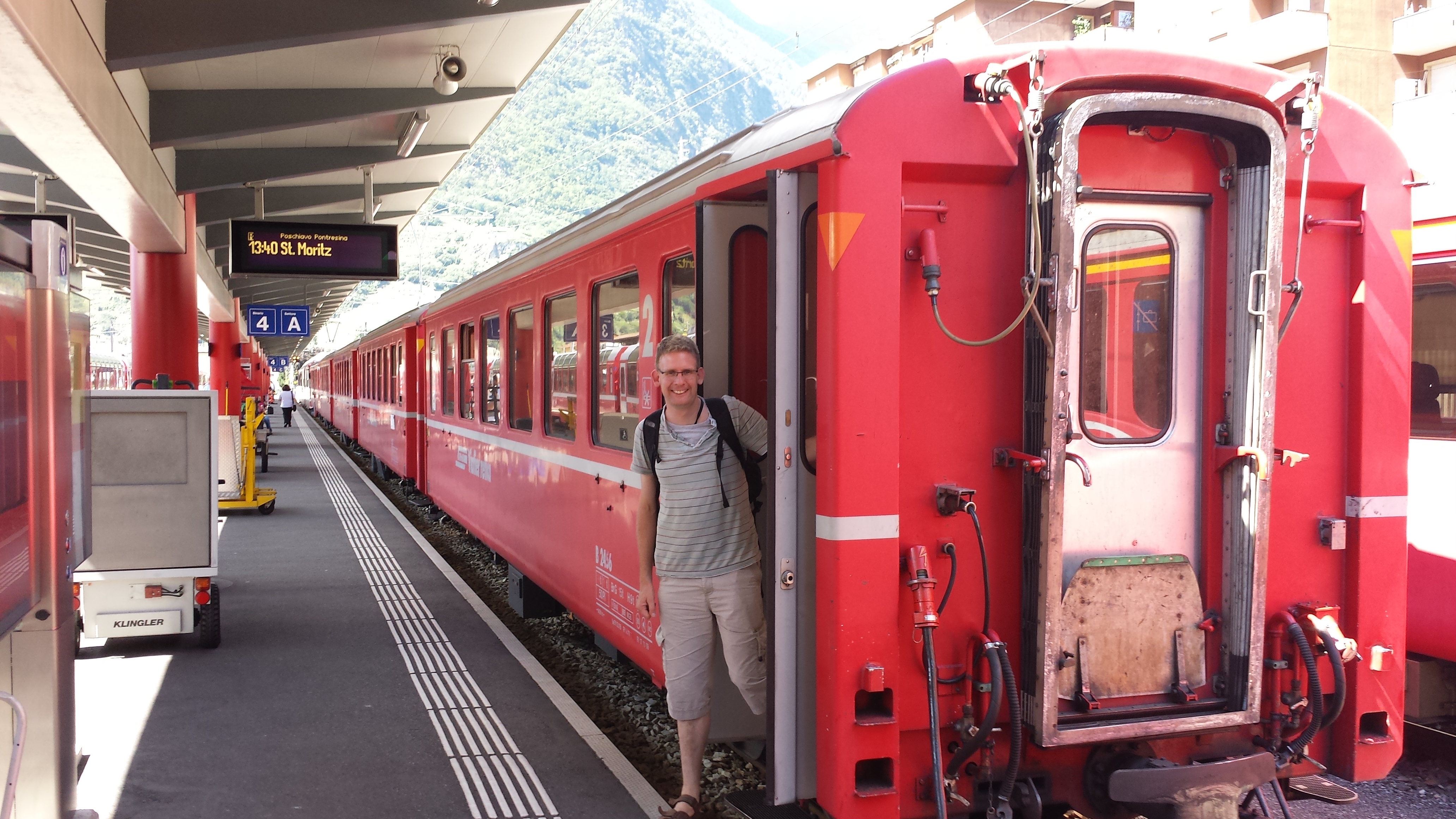
On arrival in Chur, the connecting train to St. Moritz awaits. This spotlessly clean red narrow-gauge train bustles out of the town and follows river valleys, hugging hillsides and popping in and out of tunnels. Trees, mountains, and sudden drops into deep valleys slip past the window, and before long it is time to get off. It’s possible to spend the night in St. Moritz, or to change the stop before for a connecting shuttle to Pontresina, the beginning of the Bernina route itself.

Pontresina is probably the ideal place for a stopover or short stay. The excellent and spotlessly clean youth hostel is opposite the station, and it serves good meals. It is also probably the only place you can afford to stay in Switzerland. There are plenty of walking trails – or you can do what I usually do, and just get another train.

The railway south of Chur is operated by the Rhaetian Railway and a is a quaint yet surprisingly efficient system. The rolling stock is either modern units with huge picture windows, the panorama cars of the premium ‘Bernina Express’ tourist train, or some older coaches with opening windows. Aside from the open-top cars that are sometimes attached in summer, the coaches with the opening windows are the ones to look out for. Sometimes there is even a freight wagon or two attached to the train, but I’d not recommend travelling in one of those.

20140828_132333_Android

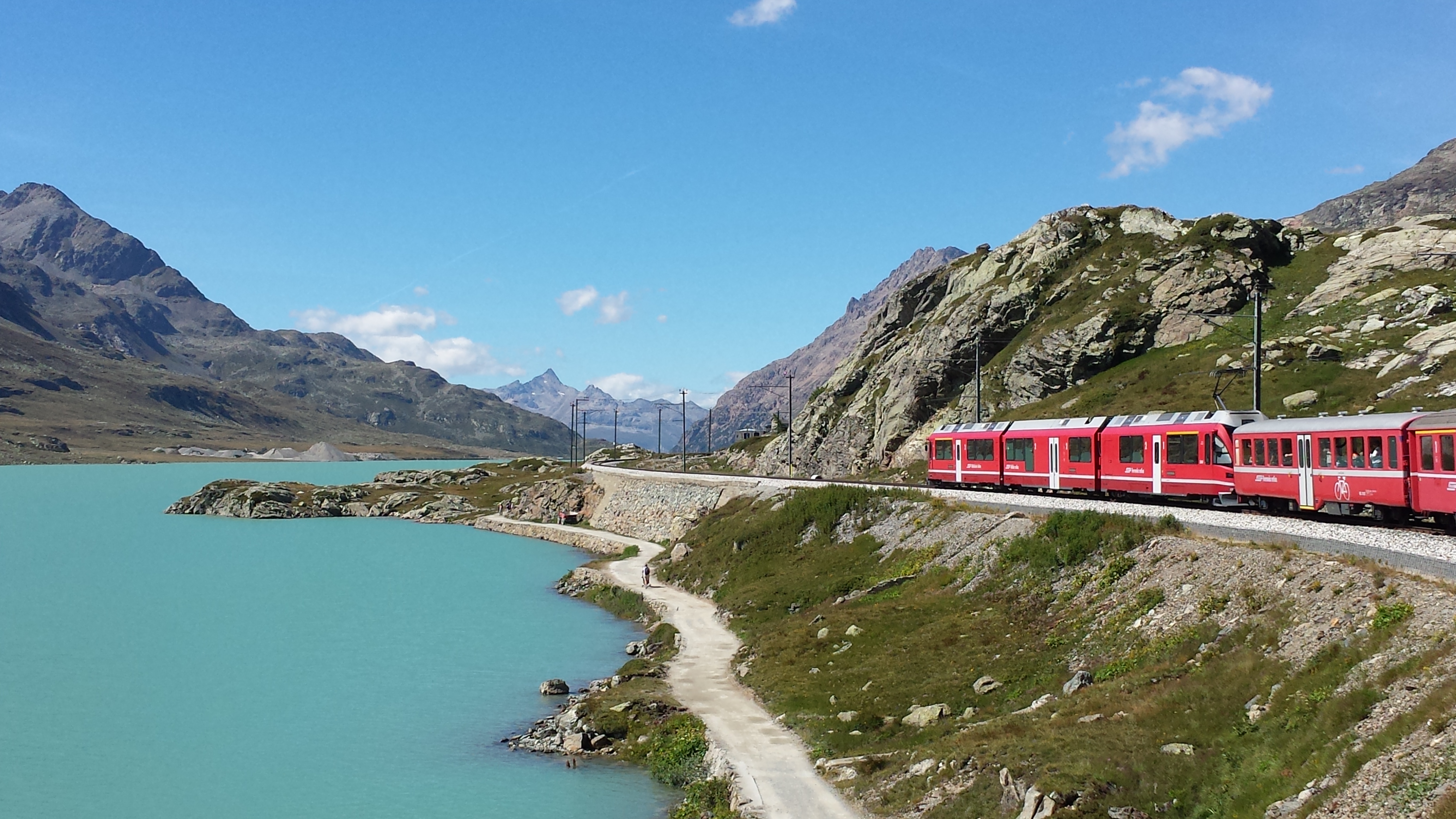
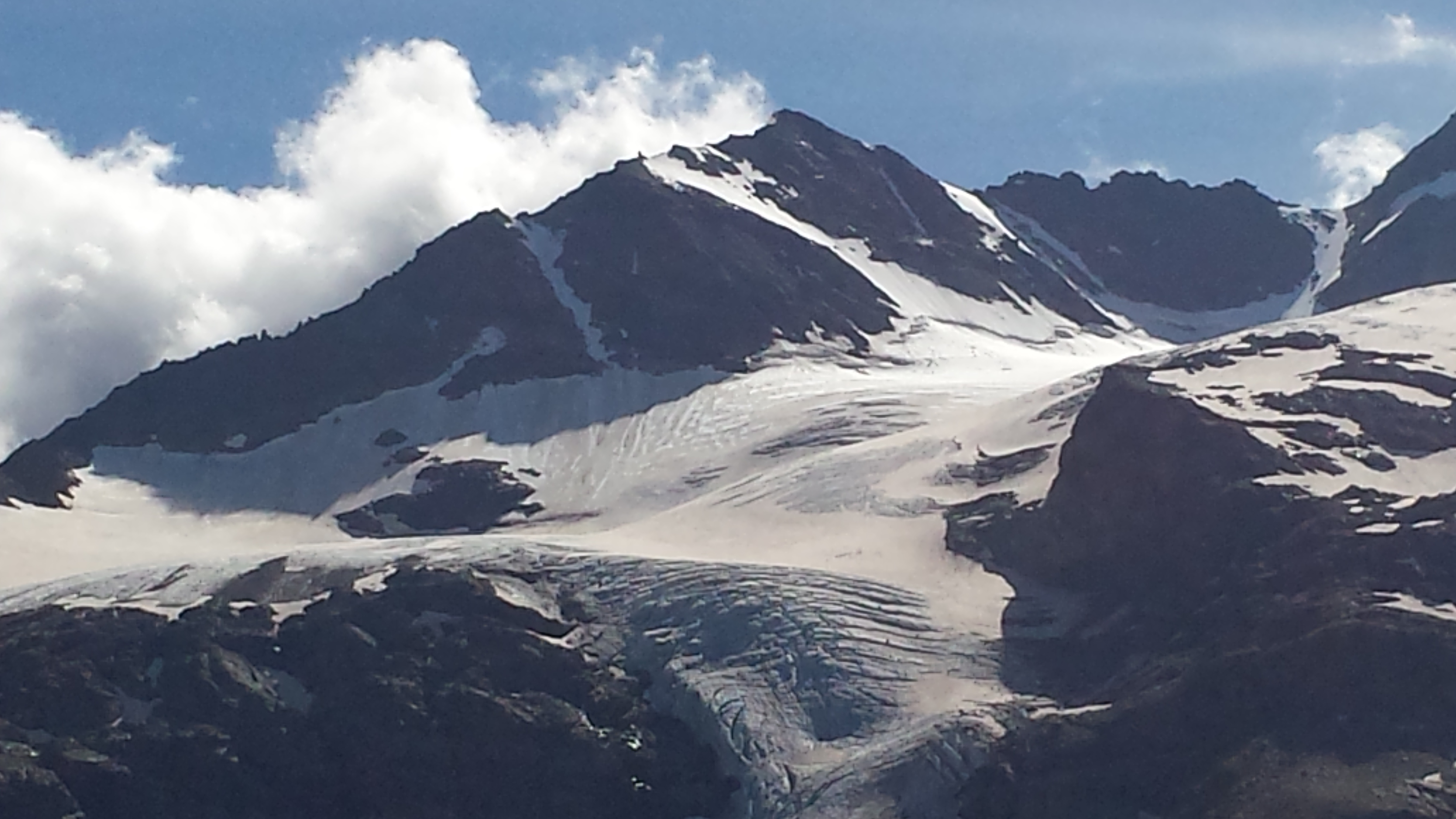
Back at Pontresina station, the train to Tirano runs every 1 – 2 hours. Most visitors travel in the premium ‘Bernina Express’, which is a great way of combining a delicious meal with delicious views – for a considerable sum of money. Personally, I’d travel in one of the regular carriages and save the cash. The views are pretty spectacular on both sides, but heading south I’d aim to sit on the right-hand side – as it gives the best views of the summit lake and the glacier. The train gradually gains height, reaching a rather chilly summit, where walkers get on and off. The summit lake is beautiful in winter, covered with ice and snow, and spectacular in summer with contrasting shades of blue. You feel on top of the world – probably because you are.

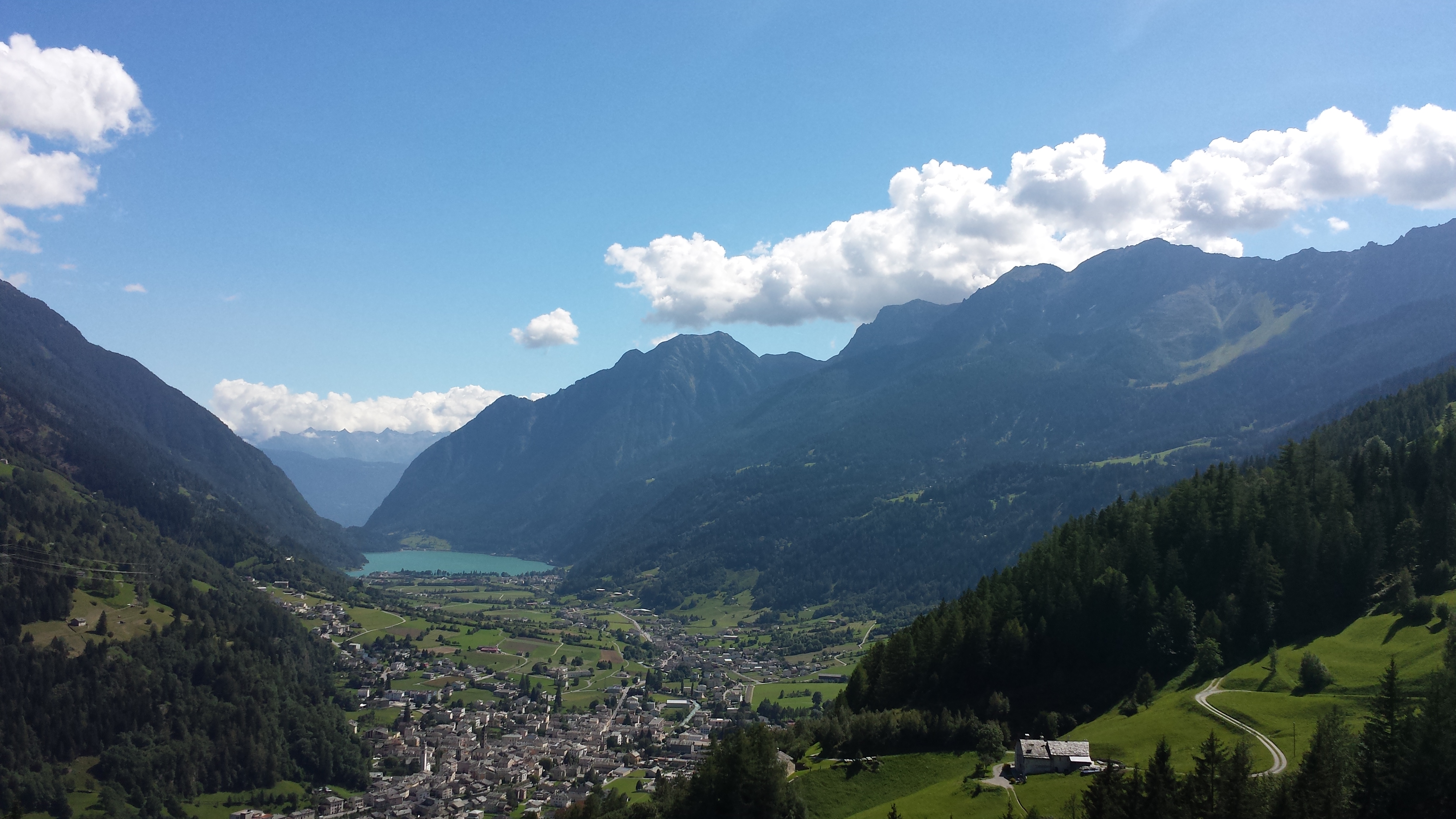
After passing the glacier, which is sadly slowly receding, the line begins to descend via a serious of loops and tunnels. The distant view down the valley to Italy is breath-taking, and it is worth putting your camera away and just enjoying the drama of the ride as the train squeals around the curves, descending lower and lower into the progressively warmer and greener valley.

20140828_143527_Android

At the station of Poschiavo (where my sister’s phone was rescued after an ‘incident’ involving a gap between the car’s window and frame), the feel of the line changes. We are now heading through verdant greenery, and at times along a road.

20140828_141429_Android

A final dramatic descent via a looping bridge that looks just out of a model railway, and a cautious crawl across the town’s main square, leads to the terminus of the Rhaetian Railway in Tirano. This is the first town in Italy, and what border control formalities that exist take place in the station’s entrance hall.

Across the forecourt from the Rhaetian Railways station is the Italian Railways’ own station, where a regular service runs to Milan, taking around 2 hours, 30 minutes. Although a more ordinary journey on rather more ordinary trains, it’s worth sitting on the right hand side for views of Lake Como, which is followed for some distance. A fast run through the Milan suburbs eventually brings the journey to an end at the monumental Milano Centrale station.

The journey will have taken longer than the fast train direct from Zurich, in fact an awful lot longer, but by travelling this way you will see places and views that some people will never see, and it really will feel as if you have actually crossed the Alps, not flown over them or charged straight underneath them.

20140828_151529_Android

A trip like this can sound expensive, and if you buy your tickets from Swiss Railways, it is. So the clever workaround is to either do the trip using an Interrail Pass, or to book it as part of a longer journey from a station in Germany, using the DB website www.bahn.co.uk Simply book your journey from, say, Baden-Baden (or another German station) to Tirano, and add in two ‘via’ points of Zurich and Pontresina. Adjust your timings and select a stopover period in each of those places, if you wish. It’s possible to stop over for up to 48 hours, so you can include an overnight break en route.

The Best Train in the World?

20181202_222918

There are few things in life that are more exciting than boarding a train, except that is, when the train concerned is a night train.

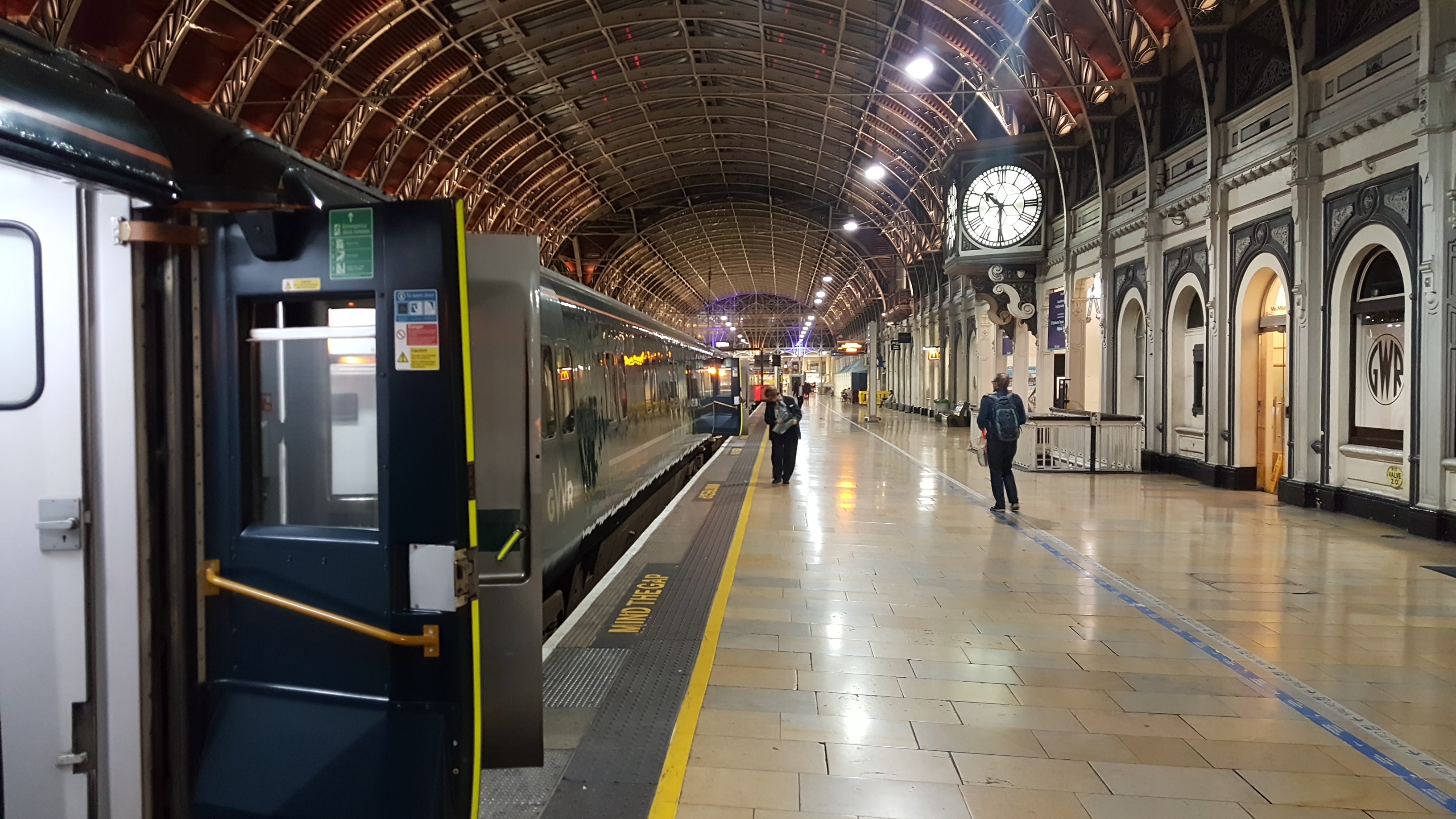
Arriving at a big station late in the evening, when the commuters have gone home, the retail outlets are shuttered, and the only passengers are rushing for the last trains, is a unique experience of stepping off the beaten track of ordinary life and starting an adventure when everyone else is heading home. The unusual (and often retro) appearance of the night train, lined up alongside the more modern rolling stock on the adjacent platforms  gives a Harry Potter-ish atmosphere to the whole experience. With blinds at some windows firmly drawn, and others open and revealing bunks and sinks and cosy compartments, and with a massive diesel or electric locomotive ticking away at the head, everything about the train suggests that this is the beginning of a very different kind of rail journey.

Over the years since I first started exploring Europe and farther afield, I’ve always made a point of taking overnight trains, partly because they are an easy and time-efficient way of travelling, but mainly because of their unique and charming atmosphere. I’ve travelled on overnight trains in Turkey, Morocco, Bosnia, Syria, Iran, Georgia, Russia, Uzbekistan, Japan, Thailand, pretty much every European country, and even the United States, but of all the overnight trains of which I’ve experienced, the one that wins hands-down, the title of ‘The Best Train Ever’ is does not require a journey across half the world, and nor need it cost a fortune neither.

The train in question is the ‘Night Riviera’ from London Paddington to Penzance. Running every night except Saturday (as even trains like a Saturday night off), it’s one of only three surviving ‘sleeper’ trains that depart each evening from the ‘Big Smoke’. The other two is the ‘Lowland’ and the Highland ‘Caledonian Sleeper’ to Scotland, but in my opinion the humble Night Riviera to the far end of Cornwall, wins all the prizes.

So what has this train got that makes it stand out?

Well, firstly it has all the good things that the two other British overnight trains do have. Passengers have lounge access at both ends of the route, where snacks and hot drinks are available and where it’s possible to have a shower. In common with the Scottish trains (it is considered bad luck to call them the Caledonian Sleepers – each are simply known by railwaymen as ‘the Scottish Train’), boarding begins an hour before departure, allowing passengers to settle into their compartments or to grab a seat in the lounge car. The lounge car is itself almost unique to British railways, existing on few trains in other parts of the world. In this case it is a plush first class carriage, with comfy seats and cosy table lamps, where it’s possible to enjoy a nightcap or snack before stumbling down the corridor to bed.

The sleeping cars are of 1980s vintage, and the compartments are of the type found on other trains throughout the world, consisting of an upper and lower bunk, a sink, and a somewhere to hang clothes. While some carriages have a distinctly 80s feel about the décor, most have now been refurbished with power sockets, stylish new furnishings, and hotel-style key cards, giving a modern flavour to an age-old mode of travel. The mattresses are comfortable, the duvets warm, the pillows ample, and the carpet, that seems to adorn every surface both horizontal and vertical, soft. The atmosphere and appearance is warm and cosy.

Less, cosy, inevitably is the walk along the corridor to the toilets. However, there are two per carriage, they are kept spotlessly clean, and can be used even when the train is stopped in a station. Having a key card also means that your stuff is safe in your compartment when you are occupied on the loo. While en-suite facilities would be nice, such things come at a premium, and as we shall see, the Night Riviera is an incredibly good value travel experience.

Everyone will have their own stories of sleep (or the lack of it) on overnight trains. Some people sleep soundly, while others talk of tossing and turning, of waking up at mysterious unadvertised halts throughout the night, of night time forays down the corridor to the loo, or of being kept awake by the train’s movement. This is the same with night trains everywhere – and all I can say from my own experience is that if you do it for two consecutive nights, you’ll always sleep well the second time!

Sleep does eventually come, often just before the steward knocks on the door with the breakfast tray. On the Night Riviera it is breakfast in bed, with a bacon roll, some biscuits, and tea or coffee, served properly with a cup, saucer, and teapot.  Sitting on the edge of the bunk, sipping a cup of tea while watching Truro Cathedral slip by, is a lovely experience. Standing half-naked at the sink, brushing your teeth while commuters on the platform at Camborne gaze idly in the window, is a more alarming experience, especially for them.

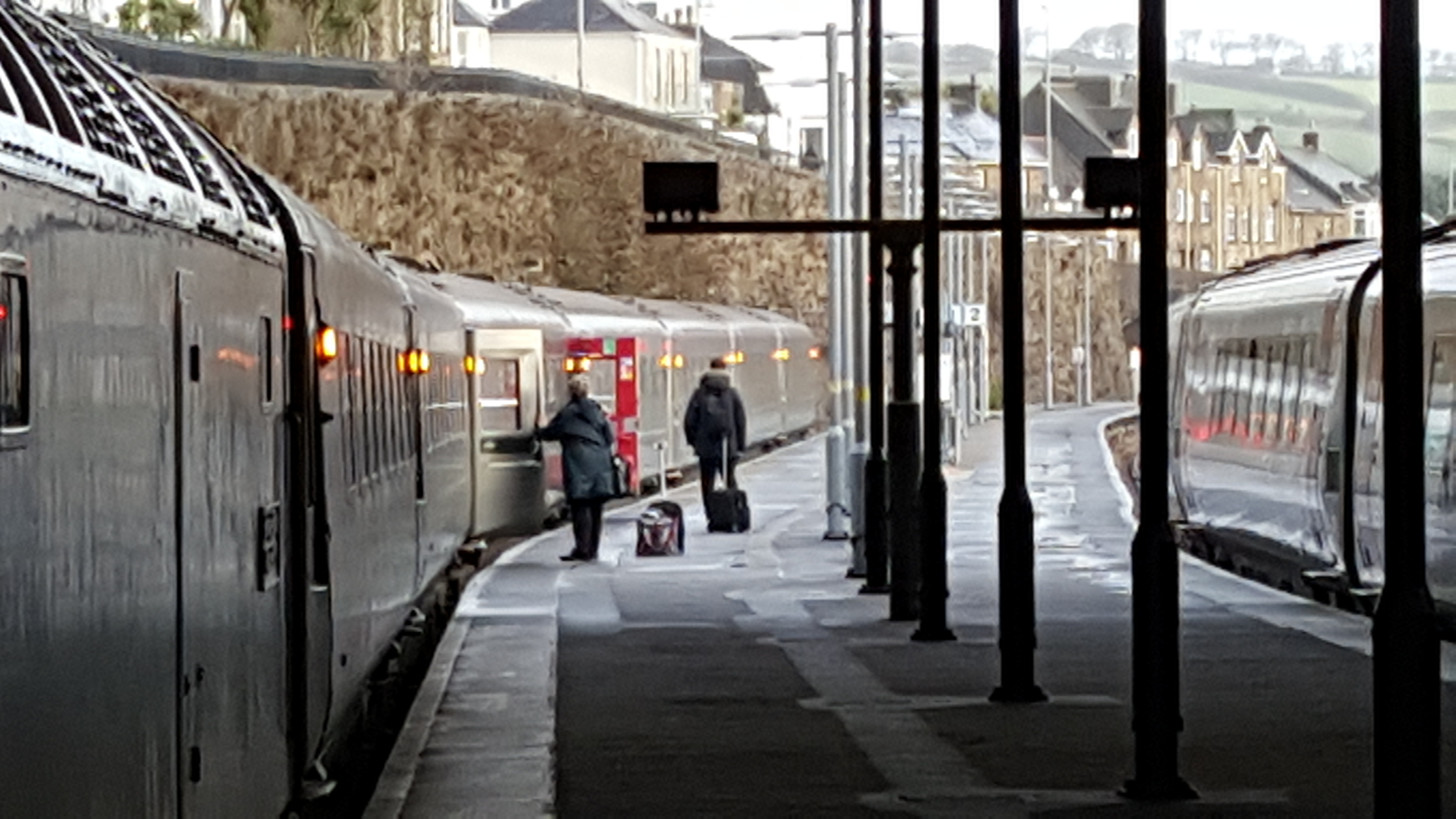
Arrival into Penzance is invariably on time. The best day to arrive is arguably a Monday, when the train gets in at 9 am, rather than the usual 8. Apart from the sleeper lounge, there’s not a lot at the station, but the town centre is a short walk away, and from the nearby bus station it’s possible to head out quickly and make the most of the day ahead at the various sights Cornwall has to offer.

The most outstanding element of the Night Riviera is the attention to detail and the standard of service. There is usually a steward for every pair of sleeping cars and they are proactive in helping passengers to find their berths, explaining how everything works, and taking orders for breakfast. Over many train journeys I’ve come across a variety of railway staff, some good, some perhaps less so, but it’s clear that those who work the Night Riviera are among the best in the railway industry. They are proud of their train and this comes across in the service they provide for their passengers. They know when you need to be looked after and – importantly on a night train – they also know when to leave you alone. When the railway wants to do things well, it always rises to the challenge – and this is certainly the case on the Night Riviera.

20181203_085744

Fares and accommodation types

Although the Night Riviera conveys ordinary seated coaches, which are accessible with ordinary tickets, for the experience I’ve just described, you’ll need to book a berth. Unlike a similar journey in continental Europe, this is not outrageously expensive. A single compartment (they call them ‘cabins’ on this service) can be obtained for as little as £49 one way if snapped up when bookings first open (around 12 weeks before departure), However these sell out very quickly, so expect fares to start from around £79 in reality, rising to £120 nearer to the day of departure – and possibly much higher if demand is high. The most that I have paid is £89, but then I tend to book at least a month ahead. It is not unknown for all the berths to completely sell out. Despite the fact that almost everyone you’ve ever met in your life has never travelled on this train, it is a popular service. While it is cheaper to share a twin compartment, it is not much more expensive to sleep alone. In contrast, the cheapest single compartment on the Vienna to Bucharest ‘Dacia Express’ is around £130 and that is without the luxurious trimmings you get on the Night Riviera!

Compartments are configured as either singles or twins (‘twin’ here meaning bunk beds). If you book a ‘single’ or ‘solo’ cabin, there will usually be just the one lower bunk. Couples travelling together can book a twin compartment and argue about who will go on top. Or if they book over the phone (as opposed to online) they can book two singles with an interconnecting door which they keep open – or firmly locked shut – as they prefer. Families can also book (over the phone) a pair of connecting twin cabins, thus making up a kind of suite.

The best way to book this service is with the Great Western Railway website, www.gwr.com. The best way to find out everything else you need about this service is on the amazing rail travel information hub of www.seat61.com

I hope this little description will tempt you to go and do likewise. Please do, it is well worth the trip.

A ferry nice way to sea Spain

20180731_205049

Ever since I was seven years’ old, when we travel to France on holiday or between the UK and ‘RAF Germany’, I have always found travelling by ferry to be the most incredibly exciting experience. As an adult, that feeling has not changed in the slightest. The prospect of a ferry sailing, preferably on a long crossing and in my own cabin is something that I always look forwards to immensely. I love too the feeling of boarding the ship for the first time, of discovering my cabin, and the sheet excitement of slowly leaving port. Once on board, a meal in cafeteria or restaurant, a drink in the bar, a somewhat aimless wander around the shop, and a cosy night listening to the sounds of the ship – these all make for the perfect start (or end) to any holiday.

20180801_194235

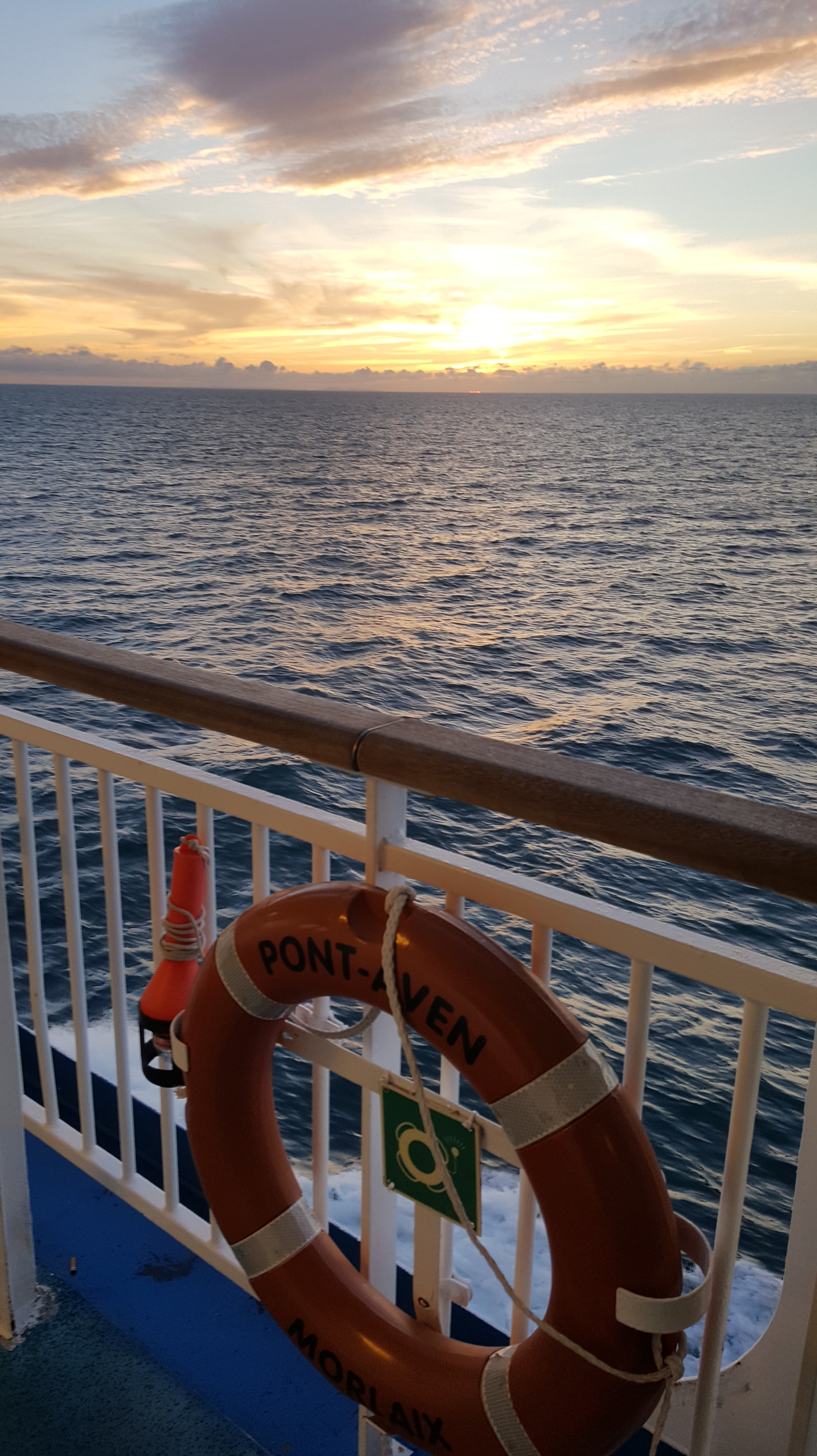
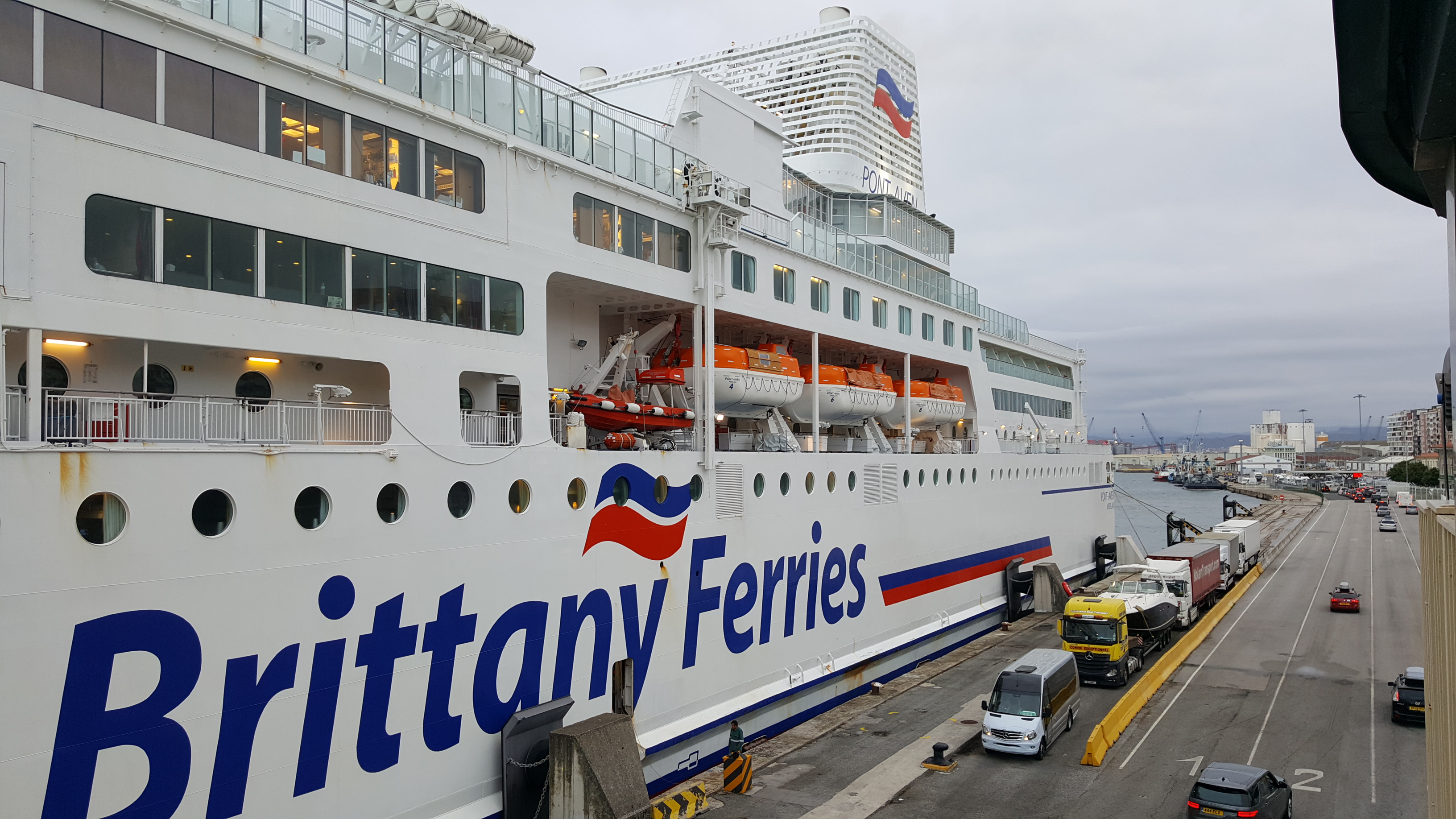
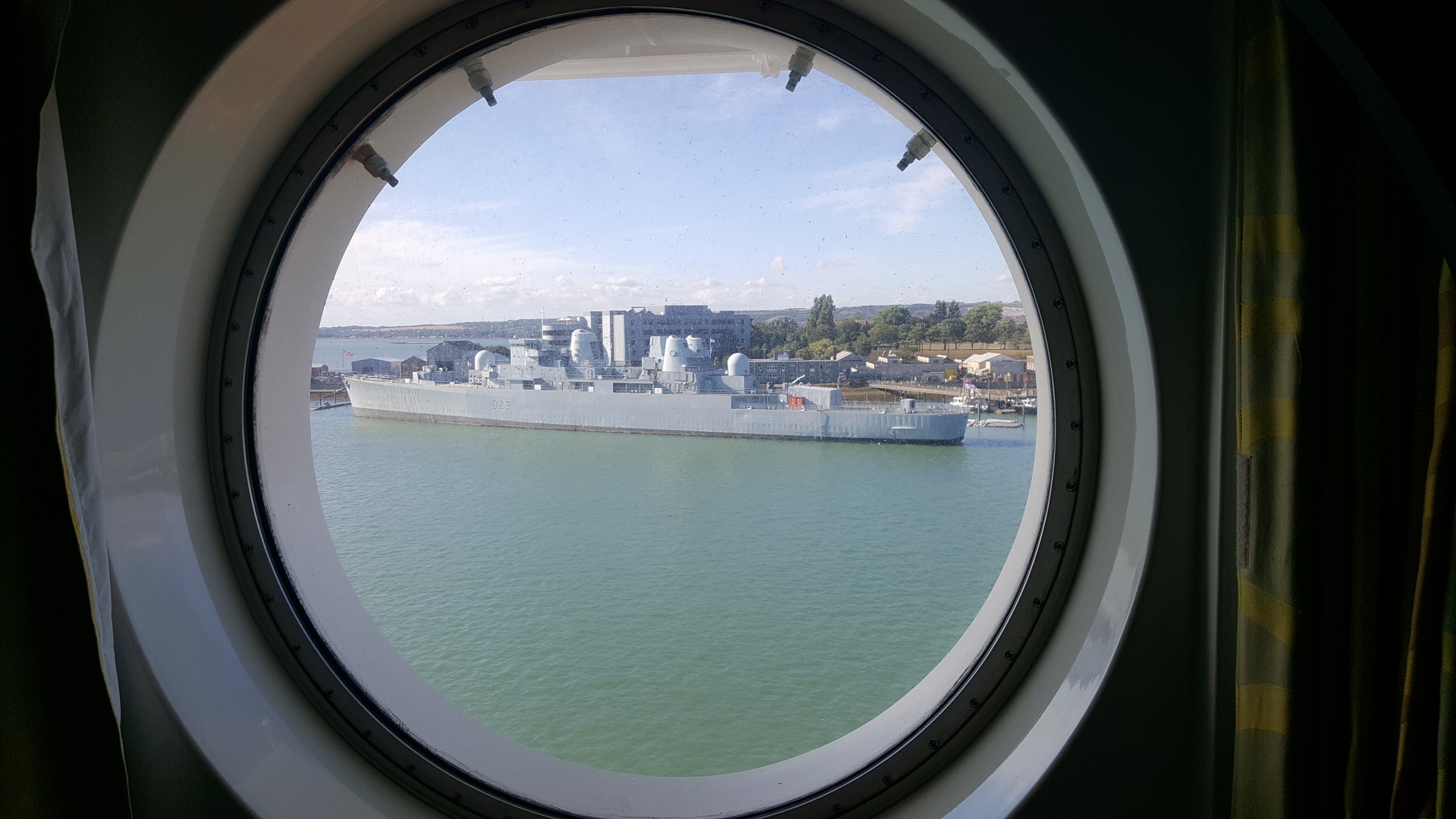
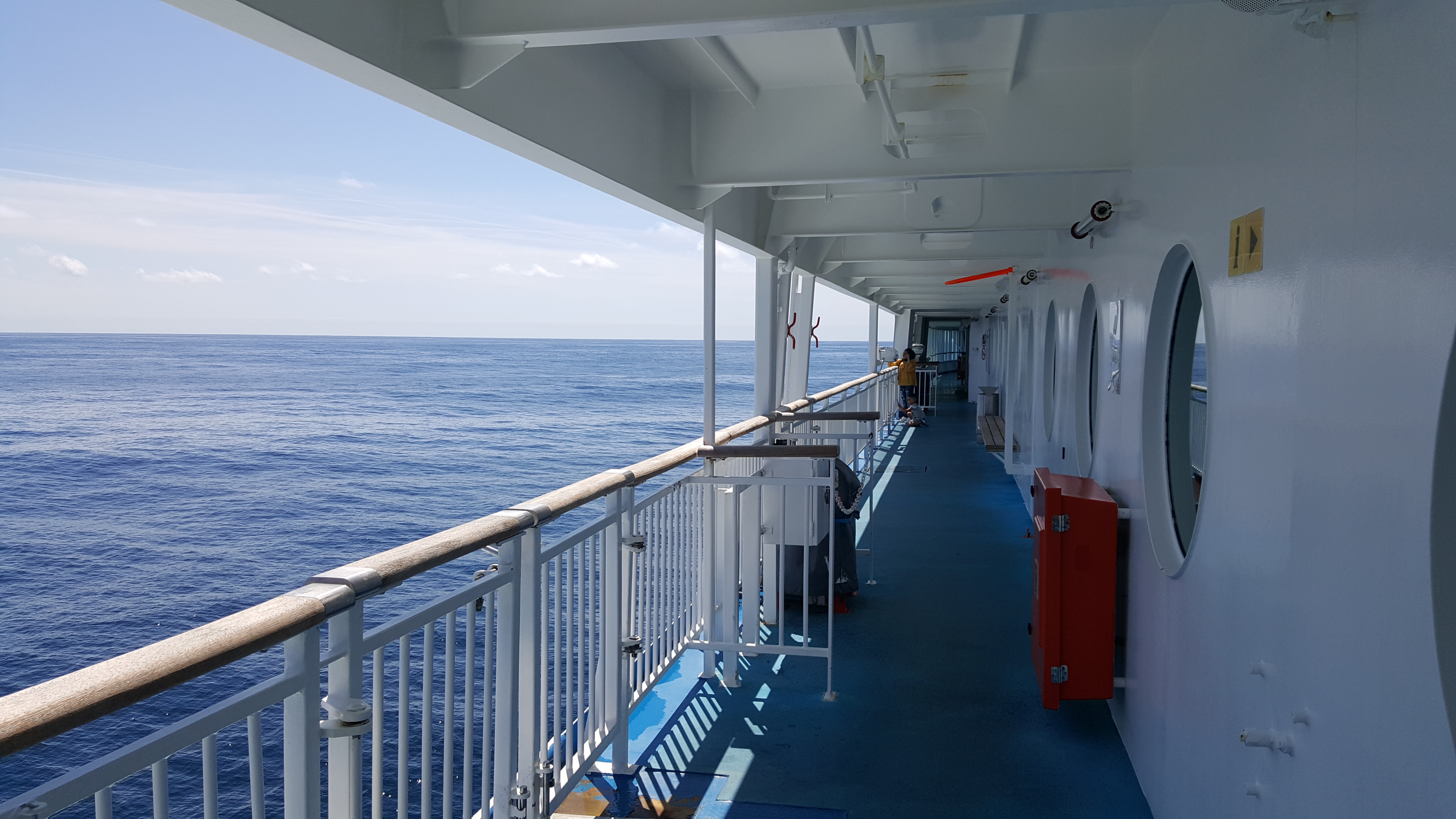
On this occasion my journey was on Brittany Ferries’ Pont Aven, their large and luxurious ‘cruise-ferry’ from Portsmouth to Santander, on the north coast of Spain. This ship has been in service for around 14 years, but is still in good condition. The most well known facility on board is its (admittedly tiny) swimming pool, but on three of my four journeys on the vessel,  it has not been on use, including today. However, with a comfortable cabin, plenty of lounges, lots of outside deck space, and fairly good-value eating and drinking options, it’s a pleasant and relaxing crossing.
Brittany Ferries was started (apparently) by a consortium of French fishermen, and although the bulk of the passengers are British, the food and general atmosphere is decidedly French.

Today’s trip is delayed by around two hours due to bad weather affecting earlier crossings. This meant a later boarding and departure from Portsmouth, but waiting and boarding at the terminal there is fairly straightforward. It’s nothing like being at an airport, and no one asked me to remove my belt, take my shoes off, or to put my belongings in a clear plastic bag.

20180731_174214

And so today, as I sit in my cabin watching the Spanish coast draw closer, calm and rested after a day of doing not very much at all, I am glad I chose to travel this way.

20180801_120431