
This series is updated and continued whenever I fancy a break from ‘parish things’ – such as late at night or on my day off…
Planning Resources
As I said in my last post, the function of planning is not to hardwire you into a rigid and unchangeable itinerary, but to enable more, not less, spontaneity. The best adventures are the ones that do not go as originally planned.
This installment focuses on the resources that can make this planning possible.
Paper or Online?
My first experience of extensive travel was in the mid 1990s. Back then the internet was a niche attraction and you had to rely on guidebooks, printed timetables, and maps. In 2021, it is possible to do away with all of these things and to rely entirely on a mobile phone. Back in the 90s, the only electronic device I carried was a travel kettle – but nowadays traveling without a mobile device is well-nigh impossible.
The whole ‘online thing’ does not mean that paper and printed resources are unnecessary, as for the best experience you really need a bit of both.
Paper resources
These are most necessary when beginning to dream and to plan – i.e. now. Yes now, in lockdown. Nothing quite stirs the imagination like a map or a book.
Guidebooks
When I first started travelling, I would carry a whole mini-library of Rough Guides and Lonely Planets. They would weigh a ton, but were an indispensable companion. I remember losing one such guide in Kiev – and seriously considering stealing an identical copy from the guy in front of me a queue – so lost did I feel without it. Google means that such heavy lifting is no longer necessary, but guidebooks are invaluable at the planning stage. Good quality guides, such as Lonely Planet, Bradt or Trailblazer, are incredibly well-researched, engagingly written, and give some of the local and historic context in a way that Tripadvisor doesn’t. The highly pictorial ‘DK Eyewitness’ guides are not so strong on practical details, but are a great way of feeding the imagination.
Another good book for ‘dreaming’ is ‘Europe by Rail’ by Nicky Gardner and Susanne Kries. It’ll give you an idea of both where to go and how to get there. It even has a website https://www.europebyrail.eu/
In addition, as not so many people buy guidebooks any more, by purchasing one, you are supporting a worthwhile sector, and those who write for them.
Maps
Google Maps is great when you are lost, but nothing beats a paper map, both when planning and on the road (or rails). You can visually explore an area, consider alternative routes and destinations, and generally get a feel for the place you are exploring, or planning to explore. A map is also a far valuable keepsake than any expensive souvenir. Especially when it is marked with your route, and stained with local food and drink.
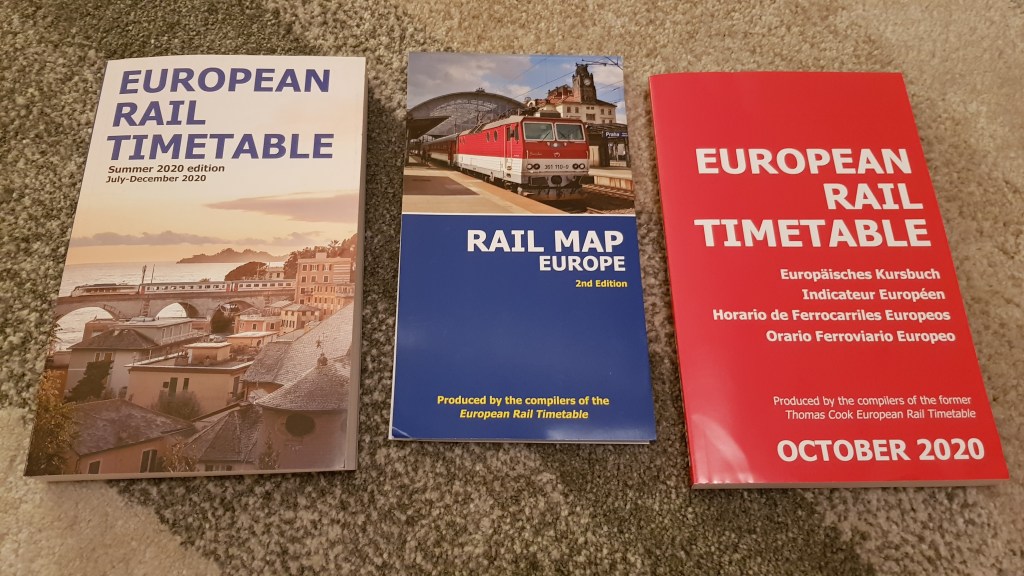
The most useful map of all is the ‘Rail Map Europe’, produced by the publishers of the European Rail Timetable (see below). It’s a handy size, with just the right level of detail. Trying to explore Europe by rail, without a such a map, and without an idea of where trains actually go, can be frustrating. So I’d get one, if I were you.
For detail on specific countries or regions, I like the’Marco Polo’ series of maps.
For city or local areas, there’s not much wrong with the various free maps available from hotels and tourist offices. They also make a great souvenir.
Timetables
Many people are scared of timetables – after all they can look confusing with all their symbols, codes, and footnotes. In many cases, there are so many apps and online journey planners that seem to make paper timetables unnecessary. But not so soon…
The problem with apps and other online resources is that while they are fine for planning one journey to one place at one specific time, they are not so good if you simply want to explore or check out how easy or not it is to get around. They give you a focused, tunnel vision on one particular connection/itinerary, but no picture at all of ‘where trains go’ or the level of service provided.
In contrast, a timetable gives you, at a glance, the full picture. At barely the flick of the page you can find first and last trains, get an idea of frequency and journey time, and see which routes are actually worth taking.
Unfortunately, many operators no longer provide such timetables, which means that the following product is pretty much a necessity…
The European Rail Timetable
This really is ‘the bible’ when it comes to travelling around Europe – and also overseas. Published several times a year, it provides rail and shipping schedules for the whole of Europe, Turkey and the former USSR, and selected editions cover other parts of the world. It was originally known as the ‘Cook’s Continental Timetable’, as it was published by the legendary Thomas Cook, until just before that outfit’s demise. The timetable is now produced independently by a team of experts for whom rail timetables are their religion – and this comes across clearly when you open the book.
It’s the only publication that will allow you to plan a journey from Staines to Shanghai by rail, or even from Killarney to Kiev. I have bought this timetable at least twice a year since 1995, and now I have an annual subscription! It is a good idea to order the special Winter or Summer editions, as they include worldwide coverage, and various traveller-friendly tips.
Now you might be wondering if I get commission for encouraging you to buy this book – but I don’t! However in current times, the future of my ‘travel bible’ is far from certain, so if you get one now, not only can you explore future trips, but you’ll make sure that I can too!
If you want to get one (and perhaps the ‘Rail Map Europe’ too), here’s the link: https://www.europeanrailtimetable.eu/
In my next installment (perhaps after the weekend) we will look at online resources. But if I were you, I’d order yourself a map and a timetable, right now in lockdown…
 Notes from the Buffet Car