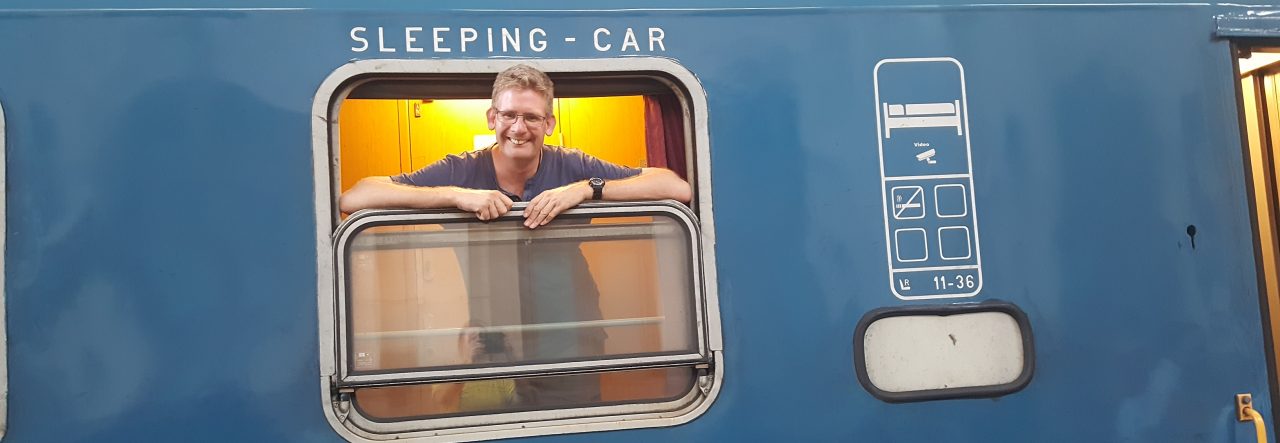
Back in 2016, my journey back from Bulgaria to Staines took me through the curious city of Tiraspol. This was not exactly the most direct route, but since it included a ride on the legendary ‘Friendship Express’ from Bucharest to Chisinau, Moldova, it was well worth the diversion.
Tiraspol is part of the territory known as Transdniestr, or ‘Transnistria’. It is the part of Moldova which lies between the Ukrainian border (to the east) and the river Nistra (to the west) as well as the unusual city of Bender on the left bank.
Although technically part of Moldova, to an outsider the language and culture of Transnistria resembles that of Russia. It is similar to my own borough of Spelthorne, which although technically part of Surrey, is often assumed by outsiders to be part of West London. In addition, while many residents of Spelthorne look back with nostalgia on the now-defunct county of Middlesex, the residents of Transnistria display a similar nostalgia for the now-defunct Soviet Union. However, unlike in Staines, the people of Transnistria voted in the early 90s (in an ‘obviously entirely free and fair’ referendum) to become an independent country.
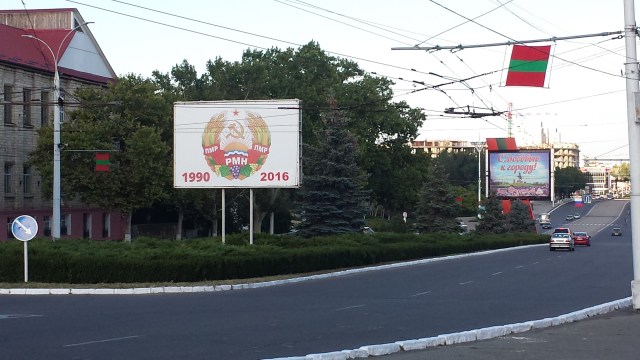
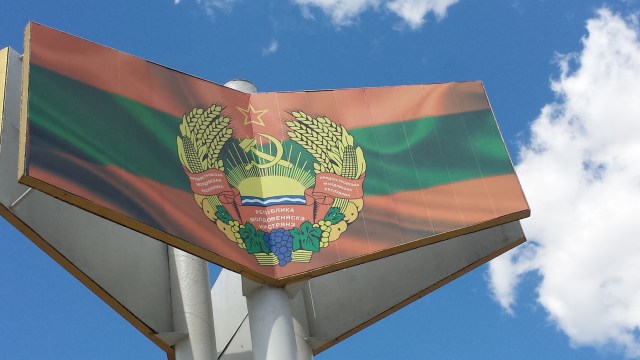
As it is in Transnistria that Moldova’s heavy industry and power stations are located, this was a rather lucrative move. After an unpleasant conflict in 1990-92, Transnistria has existed as an (albeit not recognised internationally) independent state. Although a great deal of the wealth of this ‘state’ lies in the hands of one or two wealthy Trump-like figures (who also own Transnistria’s major football teams), the country styles itself as a continuation of the Soviet Union, with the hammer and sickle displayed prominently and with roads named after Karl Marx and Lenin – whose bust seems to be on every street corner.


Transnistria does not appear to be a poor place, and the capital, Tiraspol is more clearly affluent than Moldova’s capital, Chisinau. This is not surprising as it is basically the prosperous part of Moldova following their own ‘Moldsit’!
In order to get in to Transnistria, it is necessary to pass through border posts and to fill in a migration card. A hotel booking or invitation is necessary for stays of longer thsn 24 hours. The currency is the Transnistrian Ruble, which although very attractive, is of no value anywhere else in the world (including Moldova).
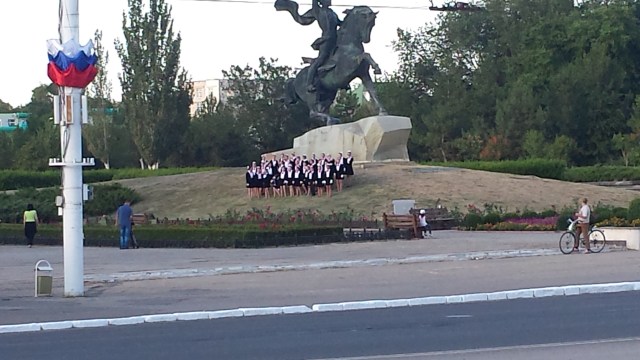
My 2016 visit to Transnistria was largely incident-free. I stayed in the luxurious Hotel Russia, where it appeared I was the only foreign guest. “Yes, Mr. Philip, I was expecting you”, said the receptionist before I could reach for my passport. When I went for a walk around the spookily deserted city centre, I couldn’t help but wonder if the schoolchildren’s choir who sang patriotic songs next to a replica tank had also been ‘expecting me’. After eating in a local restaurant chillingly named ‘Mafia’, a night in my comfortable room, and breakfast with raw toast, it was time to leave.
In the morning I headed, past the brandy distillery, to the combined rail/bus station. The platform was not exactly jammed as the twice-weekly train to Odessa rumbled in. A fellow passenger, spotting me taking a picture of the locomotive, introduced himself to me. He was an American, living in Tiraspol with his wife. I asked him why he chose to live here, and he told me that it was ‘quite nice’, that the government ‘take good care of their people’, and that he wanted to live somewhere outside the European Union. Before I could ask him what he had possibly done that caused him to want to live outside the reach of Interpol/Europol, the guard blew his whistle and I dashed aboard.
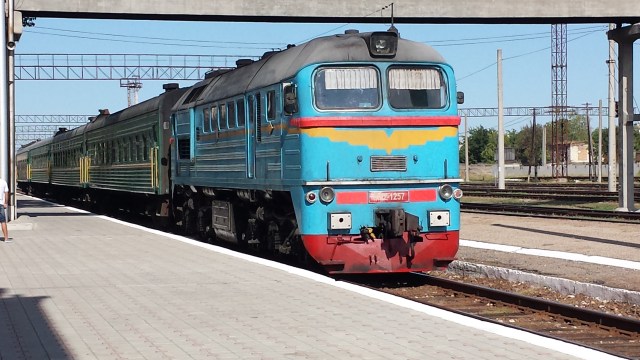
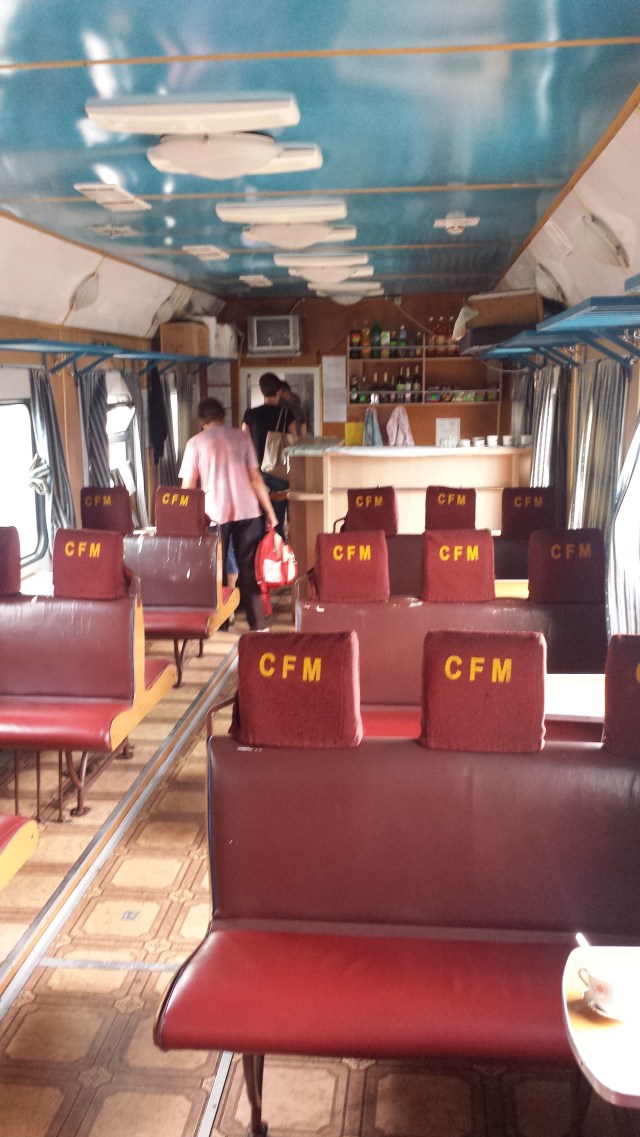
Exiting Transnistria by rail was pretty simple. The train had two classes, third class and fourth class. I was lucky enough to be in ‘third’, which was considered to be the premium option. While fourth class had wooden benches, third had cloth-covered seats and featured a small buffet. It was nice to enjoy a bit of luxury – and it was certainly a contrast from my previous visit to the ‘country’ in 2012.
Back then, I had visited Transnistria as a day trip from Chisinau. I took a local train to a station just outside the town of Bender, and followed the locals through a hole in a fence. Apparently I wasn’t supposed to do that. After a few hours mainly spent getting lost on trolleybuses and minibuses, I decided to head back to Moldova proper. However, this was where things got complicated, because having entered the Transnistria through a hole in a fence, I did not have an entry stamp. So at the ‘border’ checkpoint I was invited off the minibus for a ‘conversation’ with the guards, who looked at my passport and kept shaking their heads. Not wanting to spend the evening with them too, I asked if it was possible just to pay a fine – and indeed it was. There was, they said, a ‘paper process’ and I would just have to pay 40 US Dollars. Not having any dollars, I offered them a twenty pound note (I kept another one safely in my pocket). The guards looked at the note with a puzzled expression and despite me repeating “sterling” and “look, it’s the Queen”, they would not accept it. Did I have any Euros perhaps? But, sadly I didn’t (well, not anywhere they were looking). Eventually, worn down, they asked what money I did have. I pulled out 20 Romanian Leu (about £3.70) and they asked me what it was worth. After explaining that it was worth 40 dollars, followed by a smile and a handshake, I was off. In the end I felt rather sorry, and a little bit guilty for giving the ‘border guards’ such a small sum.

 Notes from the Buffet Car